MCA Compliance 2026: Common Filing Mistakes That Can Lead to Penalties & Director Disqualification
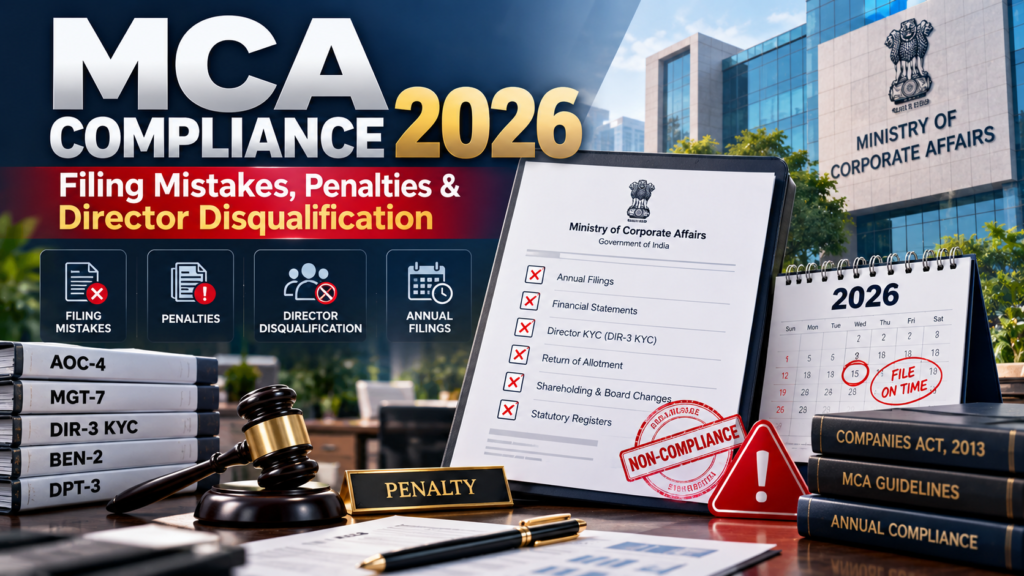
TL;DR MCA compliance is often treated as a routine administrative responsibility: prepare the financial statements, complete the annual return, upload the forms and pay the filing fee. That approach can become expensive. A seemingly minor error in an MCA filing can result in resubmission, additional filing fees, penalties, compliance notices or complications with future corporate filings. In more serious situations, prolonged statutory non-compliance can also affect the eligibility of directors. The risk becomes particularly important for companies that repeatedly miss annual filings. Under Section 164(2) of the Companies Act, 2013, a person who is or has been a director of a company that has not filed its financial statements or annual returns for a continuous period of three financial years can become disqualified for reappointment or appointment in other companies for the prescribed period. At the same time, MCA’s current V3 environment has continued to evolve. The Ministry states that the final set of company forms, including annual filing forms, is live on the MCA portal. MCA also currently reports more than 21.72 lakh active companies and more than 5.22 lakh active LLPs as of July 31, 2026. For companies, therefore, MCA compliance in 2026 should be approached as an ongoing governance process rather than a once-a-year formality. What Is MCA Compliance? MCA compliance refers to the statutory and regulatory obligations that companies must fulfil with the Ministry of Corporate Affairs and Registrar of Companies under the Companies Act, 2013 and applicable rules. Depending on the company’s structure and activities, these can include: Annual financial statement filing Annual return filing Board meeting compliance AGM compliance Director-related filings Director KYC Auditor-related filings Share allotment filings Director appointment/resignation filings Charge creation or satisfaction filings Registered office updates Share capital changes Related-party transaction compliance Deposit-related reporting MSME reporting, where applicable Statutory registers and records Event-based MCA filings MCA’s corporate-sector filing information includes forms such as AOC-4, MGT-7/MGT-7A, ADT-1, DIR-12, CHG-1, MGT-14, DPT-3 and INC-22, illustrating how broad corporate filing responsibilities can be. Why MCA Compliance Mistakes Are Becoming More Important in 2026 Companies are increasingly operating in an environment where corporate records, financial information and statutory filings need to remain consistent. A company may have correct accounting records but still face a compliance issue if: Books of accounts ≠ Financial statements ≠ MCA filing ≠ Statutory registers For example, suppose a company has issued additional shares during the year but its shareholding information, statutory registers and MCA filings have not been updated consistently. The problem may not become visible immediately. It can surface later during: Investor due diligence Bank financing Fundraising Business acquisition Tax scrutiny Corporate restructuring Valuation Merger or demerger Change in directors This is why an annual MCA filing should involve a compliance reconciliation, not simply form submission. 12 Common MCA Filing Mistakes Companies Should Avoid in 2026 1. Filing AOC-4 With Incorrect Financial Information AOC-4 is one of the most important annual ROC filings because it communicates the company’s financial statements and related documents to the Registrar. A common mistake is preparing the form directly from accounting data without conducting a final reconciliation. Companies should cross-check: Revenue Profit/loss Paid-up capital Reserves Borrowings Loans and advances Related-party transactions Fixed assets Share capital Director information Auditor information Financial statement attachments The numbers in the MCA filing should be consistent with the approved financial statements. AOC-4 and its applicable variants remain part of the MCA annual filing framework. 2. Filing MGT-7 or MGT-7A With Incorrect Shareholding Details Annual return information is particularly sensitive because it captures the company’s corporate and ownership information. Mistakes can occur in: Number of members Shareholding Promoters Directors Share capital Transfers Meetings Indebtedness Other prescribed particulars For companies filing MGT-7A or MGT-7, the applicable form must be selected correctly. MCA identifies MGT-7A as the annual return form for OPCs and small companies and MGT-7 as the annual return form for companies to which it applies. 3. Missing the Annual Filing Deadline Late filing is one of the simplest ways to create avoidable compliance costs. Companies sometimes wait until the last few days before the deadline to upload their annual filings. This creates multiple risks: Portal issues DSC problems Data validation errors Missing attachments Professional review delays Resubmission Additional fees Last-minute corrections The better approach is to prepare the annual compliance package weeks before the statutory deadline. 4. Ignoring Director KYC Director-related compliance is another area where companies can become non-compliant. Companies should regularly verify: DIN status Director’s personal details Mobile number Email address KYC status DSC validity MCA user profile MCA has specifically provided guidance around DIR-3 KYC and continues to operate the director-related filing ecosystem through its current portal. A director’s KYC issue can become especially problematic when the company needs to file another form requiring the director’s authentication. 5. Not Filing DIR-12 After Director Changes Suppose a director: Resigns Is appointed Is reappointed Changes designation The company’s internal records may be updated, but the corresponding MCA filing must also be reviewed. DIR-12 is used for reporting particulars of appointment of directors and key managerial personnel and changes among them. A mismatch between: Board Resolution → Minutes → Statutory Register → DIR-12 → MCA Master Data is a common compliance weakness. 6. Forgetting Share Allotment Filings Companies frequently focus on accounting entries when issuing shares and overlook the corporate filing requirements. If shares are allotted, the company should review whether the relevant return of allotment and associated compliance have been completed. This becomes particularly important for startups after: Seed investment Angel investment Rights issue Private placement Conversion of securities Bonus issue A funding transaction should therefore trigger a corporate compliance checklist, not just an accounting entry. 7. Failing to Register or Update Charges Where applicable, companies must properly address charges created, modified or satisfied in connection with secured borrowings. A company may have: Loan Agreement → Security → Charge → MCA Filing If the charge-related filing is missed or delayed, the company’s MCA records may not properly reflect its secured obligations. MCA’s corporate filing framework includes CHG-1
Company Incorporation in 2026: Private Limited Company vs LLP – Which Structure Is Better?

TL;DR Introduction Choosing the right legal structure is one of the most important decisions when starting a business in India. In 2026, entrepreneurs commonly compare two structures: a Private Limited Company and a Limited Liability Partnership (LLP). Both provide limited liability protection and create a separate legal structure for carrying on business, but they are designed for different types of businesses. A startup planning to raise venture capital may have very different requirements from a professiona l consultancy operated by two or three partners. Similarly, a family-owned business focused on controlled ownership may not need the same corporate structure as a technology company planning multiple investment rounds. The question, therefore, is not simply “Is LLP better than Private Limited Company?” The better question is: “Which structure fits the ownership, funding, taxation, compliance and growth plans of your business?” MCA’s current ecosystem supports both company and LLP incorporation through its electronic incorporation processes. MCA’s current portal also shows substantial incorporation activity, with more than 21 lakh active companies and more than 5 lakh active LLPs as of July 31, 2026. Private Limited Company vs LLP: Quick Comparison Factor Private Limited Company LLP Governing law Companies Act, 2013 LLP Act, 2008 Separate legal entity Yes Yes Limited liability Yes, subject to law Yes, subject to law Minimum members/owners 2 members 2 partners Management structure Directors Designated partners/partners Ownership representation Shares Partnership contribution/rights External equity funding More suitable Generally less suitable Venture capital Preferred structure Usually not preferred ESOP-style equity incentives More suitable More restrictive Compliance burden Generally higher Generally lower Flexibility in internal arrangements Structured Relatively flexible Annual filings Multiple corporate compliances Annual LLP filings Suitable for Startups, scalable businesses, funded ventures Professional firms, closely held businesses, partnerships Conversion to other structures Possible subject to law Possible subject to applicable provisions What Is a Private Limited Company? A Private Limited Company is a company incorporated under the Companies Act, 2013. It is a separate legal entity from its members and operates through its directors and shareholders. The ownership of a private company is represented through shares. This structure is commonly selected by businesses that intend to: Build a scalable business Bring in investors Issue equity Create structured ownership Raise venture capital Introduce employee equity incentives Expand operations Build a formal corporate structure Potentially undertake mergers or acquisitions For incorporation, the MCA’s SPICe+ framework integrates several incorporation-related services, including name reservation, incorporation and PAN/TAN-related processes. What Is an LLP? A Limited Liability Partnership combines elements of a partnership with limited liability protection. It is governed primarily by the Limited Liability Partnership Act, 2008. An LLP is also a separate legal entity, while its internal relationship between partners is largely governed by the LLP agreement. The MCA’s FiLLiP process is used for LLP name reservation and incorporation and can also facilitate DPIN, LLP registration and PAN/TAN-related services. An LLP can be particularly useful where: Two or more professionals operate together Partners want flexibility in profit sharing External equity investors are not a major requirement The business is closely held Lower recurring compliance is desirable Partners want a partnership-style operating arrangement with limited liability Private Limited Company vs LLP: Liability Protection Both structures provide limited liability protection, but the legal framework is different. Private Limited Company Shareholders generally have liability limited to their investment or unpaid amount on shares, subject to applicable law and circumstances. LLP The LLP is a separate legal entity and partners generally have limited liability in accordance with the LLP Act. However, limited liability should not be interpreted as absolute protection. Fraud, wrongful acts, statutory violations and certain personal guarantees or obligations can create personal exposure. Therefore, the choice between LLP and Private Limited Company should not be based solely on the phrase “limited liability.” Ownership Structure: Shares vs Partnership Interest This is one of the biggest practical differences. Private Limited Company Ownership is represented through shares. This makes it easier to structure: Founder ownership Investor ownership Share transfers New share issuance Different classes of securities, where permitted Employee equity arrangements For a startup that expects multiple funding rounds, this structure is usually more adaptable. LLP An LLP does not operate through share capital in the same manner as a company. Partners contribute capital according to the LLP agreement, and the agreement can establish how: Profits are distributed Responsibilities are allocated Contributions are made Management decisions are taken Partner rights operate This flexibility can be valuable for professional and closely held businesses. Funding: Which Is Better for Investors? If external equity investment is part of the business plan, a Private Limited Company generally has a significant advantage. Investors are accustomed to investing through equity shares in companies. A company can create a structured cap table showing: Founders → Angel Investors → Venture Capital → Strategic Investors → Employee Equity An LLP does not offer the same conventional equity-share structure. This does not mean an LLP cannot receive outside investment or financial support. However, the structure is generally less suitable for businesses whose core strategy involves repeated equity fundraising. If You Plan to Raise Venture Capital A Private Limited Company is usually the more practical choice. If You Plan to Remain Partner-Owned An LLP may be more appropriate. Taxation: Private Limited Company vs LLP Tax should be considered carefully because the most tax-efficient structure depends on the business’s profitability, distribution strategy, deductions, remuneration, reinvestment plans and other facts. For AY 2026-27, the Income Tax Department states that partnership firms, including LLPs, are taxable at 30%, subject to applicable surcharge and cess. It also notes AMT provisions for firms/LLPs in applicable circumstances. Domestic companies have different tax regimes. For AY 2026-27, the Income Tax Department lists multiple corporate tax options, including the 22% rate under Section 115BAA for companies satisfying the applicable conditions. Other company tax rates can apply depending on the regime and eligibility. This is why comparing only the headline tax rate can be misleading. The actual decision should consider: Business profit Proposed remuneration Profit distribution Dividend strategy Deductions MAT/AMT
Companies Act Compliance 2026: Complete Annual Compliance Checklist for Private Limited Companies
Introduction Annual compliance under the Companies Act is not limited to filing AOC-4 and MGT-7 once a year. A private limited company has continuing responsibilities relating to board meetings, statutory registers, financial statements, annual general meetings, director-related filings, auditor requirements, share capital, loans, deposits, related-party transactions and event-based disclosures. For 2026, companies also need to pay closer attention to the MCA V3 filing environment and the latest form architecture. The Ministry of Corporate Affairs has confirmed that the final set of company forms, including annual filing forms, is live on the MCA V3 portal. This makes an annual compliance review important well before the company’s AGM and ROC filing deadlines. Whether you operate a startup, family-owned business, manufacturing company, professional services firm or growing private limited company, maintaining a structured compliance calendar can help prevent late fees, notices, filing restrictions and avoidable regulatory complications. What Is Companies Act Compliance? Companies Act compliance refers to the statutory requirements that a company must follow under the Companies Act, 2013 and applicable rules. These requirements can include: Holding Board Meetings Maintaining statutory registers and records Preparing and approving financial statements Preparing the Board’s Report Conducting the Annual General Meeting Filing financial statements with the ROC Filing annual return with the ROC Maintaining director-related compliance Filing event-based forms Complying with auditor-related requirements Filing applicable MSME, deposit and other returns Maintaining registered-office and company records Complying with applicable related-party, loan and investment provisions The exact compliance burden depends on the company’s size, nature of business, turnover, capital, borrowing, shareholding structure and transactions during the year. Private Limited Company Annual Compliance Checklist 2026 A practical annual compliance review should cover the following areas. Compliance Area Common Form / Requirement Applicability Financial Statements AOC-4 / applicable variant Generally applicable Annual Return MGT-7 / MGT-7A where applicable Depends on company type AGM Annual General Meeting Generally applicable Board Meetings Board meeting requirements Generally applicable, subject to exemptions Director KYC DIR-3 KYC / applicable process Applicable to directors as prescribed Auditor ADT-1 / auditor-related compliance where applicable As applicable MSME reporting MSME-1 If applicable Deposits / specified receipts DPT-3 If applicable Shareholding / beneficial ownership Applicable statutory filings If applicable Significant transactions Relevant event-based forms If applicable Charges CHG forms If applicable Director changes DIR-12 If applicable Share allotment PAS-3 If applicable Resolutions MGT-14 where applicable Depends on resolution/transaction Registered Office INC-22 where applicable On relevant change Related Party Transactions Board/shareholder approvals and disclosures If applicable MCA’s own material identifies forms such as AOC-4, MGT-7, ADT-1, DIR-12, CHG-1, MGT-14 and DPT-3 among the key Companies Act filings used for corporate compliance. 1. Hold the Annual General Meeting The AGM is one of the most important annual compliance events for a company. The company should ensure that: The AGM is convened within the applicable statutory timeline. Proper notice is issued. Financial statements are placed before members. The auditor’s report is considered. The Board’s Report is presented. Ordinary and special business is handled appropriately. Minutes and attendance records are maintained. Applicable resolutions are properly documented. The AGM should not be treated as an isolated event. The financial statements, Board’s Report, auditor’s report and statutory records should be prepared and reviewed before the meeting. 2. Prepare and Approve Financial Statements The company must prepare its financial statements in accordance with applicable accounting and corporate-law requirements. Depending on the company, the compliance package can include: Balance Sheet Statement of Profit and Loss Cash Flow Statement, where applicable Notes to Accounts Significant accounting disclosures Auditor’s Report Board’s Report Other applicable statements and annexures A major compliance risk occurs when accounting records and MCA filings do not match. For example, differences in: Paid-up capital Shareholding Director details Loans Related-party transactions Turnover Outstanding liabilities Borrowings can create questions during later regulatory review. 3. File AOC-4 With the ROC AOC-4 is used for filing the company’s financial statements and related documents with the Registrar of Companies under Section 137 of the Companies Act, subject to the applicable form and filing requirements. Before filing AOC-4, companies should conduct a final consistency check of: Financial statements Auditor’s report Board’s Report AGM details Share capital Directors Related-party disclosures Loans and advances Subsidiaries or associates, where applicable Other mandatory attachments AOC-4 should therefore be treated as part of a broader financial statement compliance process rather than simply an online form submission. 4. File the Annual Return The annual return provides a snapshot of the company’s corporate information and activities. Depending on the company’s classification, the applicable annual return form may differ. For companies to which MGT-7 applies, the filing captures important information relating to the company, members, shareholding, directors, indebtedness and other prescribed particulars. The Companies Act specifically provides requirements concerning annual returns and their signing/certification, with different provisions applicable to OPCs, small companies and other companies. Before filing, verify: Registered office details Principal business activities Share capital Members Shareholding pattern Directors and KMP Meetings Indebtedness Penalties and regulatory actions, where applicable Related disclosures 5. Complete Director KYC Compliance Director-related compliance should be reviewed separately. Companies should verify the DIN status of all directors and ensure that applicable KYC requirements are completed within the prescribed timeline. This is especially important where: A director has changed mobile number Email details have changed Personal information has changed DIN-related information needs updating The director has not completed the applicable KYC process MCA has also highlighted operational guidance around DIR-3 KYC and V3 user/DSC requirements, making it important for companies and directors to keep their MCA profiles properly maintained. 6. Review Board Meeting Compliance Annual compliance is not only about ROC forms. Companies should verify whether the required Board Meetings were conducted and whether proper records were maintained. Review: Number of Board Meetings Notice of meetings Agenda Attendance Minutes Interested-director disclosures Approval of financial statements Approval of Board’s Report Related-party transactions Loans and investments Borrowings Major contracts Other statutory matters Applicable exemptions for certain private companies should also be considered before concluding that a particular requirement applies. 7. Check Auditor Compliance The company’s auditor-related
GST Registration in 2026: New Verification Rules, Common Rejection Reasons & How to Avoid Them
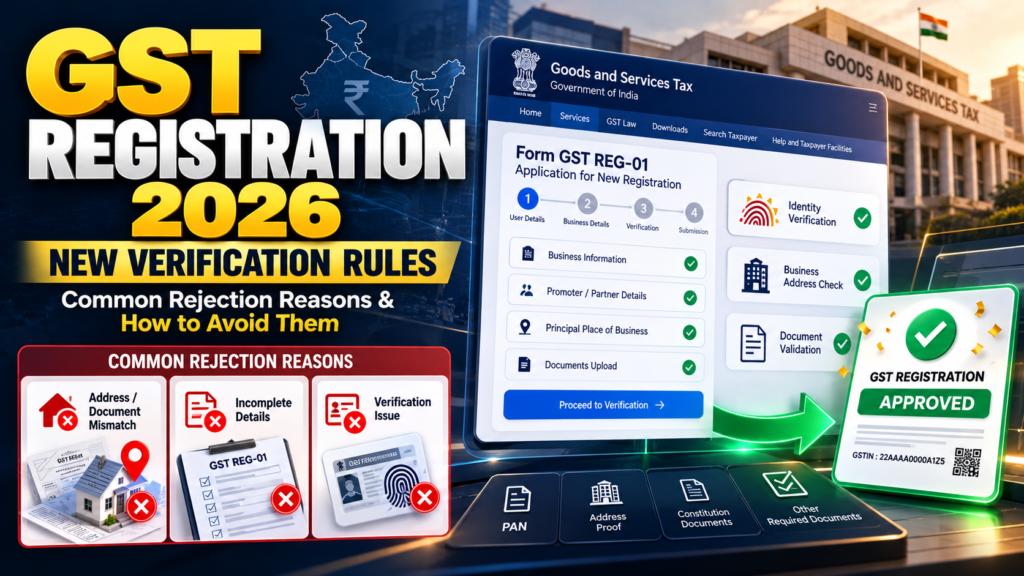
GST Registration in 2026: Why Applications Are Facing Greater Scrutiny GST registration is often treated as a simple online form-filling exercise. For a business owner, the process may appear straightforward: Create application → Upload documents → Complete authentication → Receive GSTIN But a registration application is also a verification exercise. The GST portal validates information submitted by the applicant, and the application can involve Aadhaar authentication, document checks and, depending on the circumstances, verification by the tax officer. Incorrect business details, inconsistent documents, address-related issues, authentication failures or unclear supporting evidence can result in queries, delays or rejection. The GST portal’s current registration guidance confirms that Aadhaar authentication is integrated into the registration process and that the treatment of the application differs depending on whether Aadhaar authentication is successfully completed. Where Aadhaar authentication is successfully completed, the application can be deemed approved within the prescribed 7-working-day framework if no action is taken by the tax officer. Where Aadhaar authentication is not opted for, the application is subject to mandatory site-visit verification and a longer deemed-approval timeline. That makes one thing clear: GST registration in 2026 is not just about submitting the form. It is about making sure the information submitted can be independently verified. What Is GST Registration? GST registration is the process through which an eligible person or business obtains a GST Identification Number (GSTIN) and becomes registered under the applicable GST framework. Once registered, a business may have obligations relating to: GST invoicing Tax collection GSTR-1 GSTR-3B Input Tax Credit E-invoicing, where applicable E-way bills GST payments Annual or other applicable compliance Record maintenance For businesses crossing the applicable registration threshold or otherwise becoming liable under GST provisions, obtaining registration correctly is the first step toward compliant operations. But an incorrect registration can create problems later. What Has Changed in the GST Registration Verification Process? It is important to distinguish between new legal changes and the GST portal’s existing verification framework. Aadhaar authentication, e-KYC and verification mechanisms have been part of GST registration for several years, but the compliance environment continues to become increasingly data-driven. The GST portal currently provides Aadhaar authentication options based on the constitution of the business. For example, the authentication framework identifies the relevant persons for proprietorships, partnerships, companies, LLPs and other entities. The portal also has mechanisms for document upload, verification and application processing. This means that businesses should approach registration as a data-consistency exercise. Your: PAN → Legal name → Business constitution → Authorized signatory → Address → Ownership documents → Bank details → Supporting documents should tell the same story. If these records contradict one another, the application becomes more vulnerable to clarification requests or rejection. 8 Common Reasons GST Registration Applications Get Rejected in 2026 1. Principal Place of Business Cannot Be Properly Verified One of the most common problem areas is the principal place of business. The address entered in the GST application should correspond with the documents submitted as proof. Potential problems include: Incorrect address Incomplete address Wrong PIN code Mismatch between rent agreement and application Address not matching electricity bill Property owner’s name mismatch Missing ownership/occupancy evidence Inadequate consent documentation Business operating from an address without adequate supporting proof For businesses operating from rented premises, the documentation should clearly establish the relationship between the applicant and the premises. For owned premises, appropriate ownership/address evidence should be maintained. The GST portal also uses the PIN code entered in the principal place of business section to determine the relevant State and Centre jurisdiction. Therefore, even a basic address-entry error can create downstream problems. 2. Aadhaar Authentication Failure Aadhaar authentication is an important part of the GST registration process for applicable applicants. The portal provides an Aadhaar Authentication tab during registration and identifies the persons required to undergo authentication based on the constitution of the business. Authentication can fail for various reasons, including issues connected with: Aadhaar details Name mismatch Authentication status Aadhaar locking/biometric-related issues Incorrect details Authentication link issues GSTN has previously enhanced the Aadhaar authentication failure communication to provide information such as the authentication response code and the reason for failure, including certain Aadhaar or biometric-related reasons. How to Avoid It Before starting the application: PAN details + Aadhaar details + authorized signatory details should be checked for consistency. Do not leave Aadhaar authentication until the last moment. 3. PAN and Legal Name Mismatch The GST registration system validates PAN-related information. A mismatch between the legal name associated with PAN and the name entered in the application can create validation issues. The GST portal’s documentation confirms that PAN validation checks whether the PAN details correspond with the legal name and other relevant information. This becomes particularly important when businesses have: Recently incorporated Changed their legal name Converted business constitution Added or removed partners Changed authorised signatories Best Practice Before submitting REG-01, verify: PAN → Legal name → Constitution → Incorporation/partnership documents Do not manually guess the legal name. Use the name exactly as supported by the relevant official records. 4. Incorrect or Incomplete Supporting Documents Uploading documents is not enough. The documents must be: Relevant Legible Complete Consistent with the application Properly signed where required Uploaded in the prescribed format The GST portal specifically warns that blank documents cannot be uploaded and may require re-uploading. It also warns applicants where an uploaded document is unclear or difficult to read. Common documentation problems include: Blurry electricity bill Incomplete rent agreement Missing owner consent Incorrect business address Expired documents Document uploaded under the wrong category Different names across documents Missing pages Unreadable scans A registration application can fail because the underlying information is correct but the evidence is inadequate. 5. Business Constitution Details Do Not Match The GST application asks for information about the constitution of the business. This may include: Proprietorship Partnership LLP Private company Public company HUF Trust Society Other applicable categories The information should correspond with the underlying legal documents. For example, a partnership application should be consistent with the partnership deed and PAN details. A
GST ITC in 2026: New Compliance Risks Businesses Must Watch Before Claiming Credit
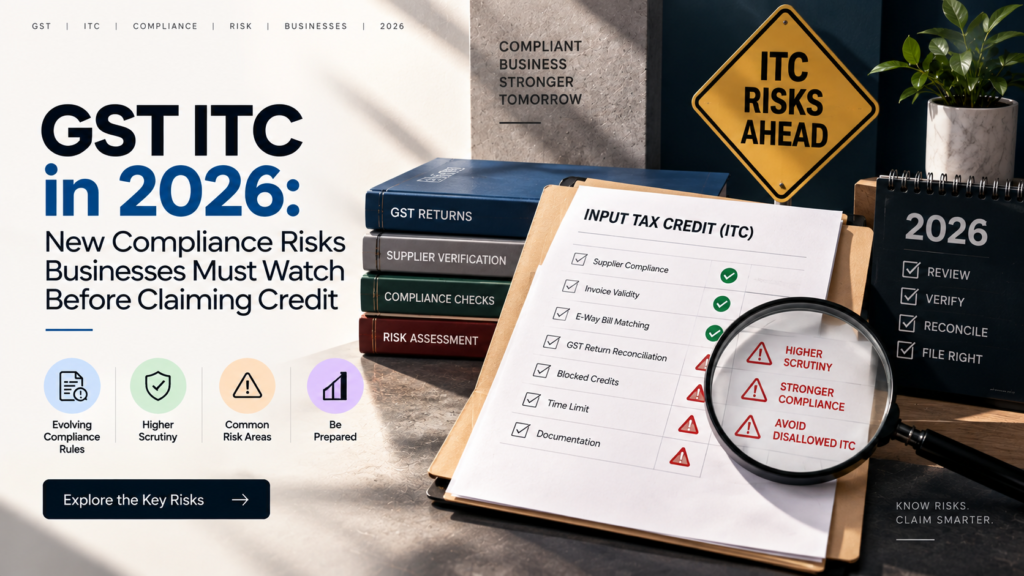
TL:DR Input Tax Credit remains one of the biggest working-capital advantages under GST. But in 2026, simply having a tax invoice and seeing an amount in GSTR-2B is not enough to treat every rupee as automatically claimable. The GST system increasingly relies on data matching, return analytics and supply-chain verification. Businesses therefore need to look beyond the invoice and ask a more important question: Is this ITC legally eligible, properly supported, correctly reflected and capable of surviving departmental verification? GSTN’s own guidance makes this distinction clear. GSTR-2B is an auto-drafted statement based on information furnished by suppliers and other specified sources, but taxpayers are still required to self-assess ITC eligibility. There can be situations where credit is not available even though it appears in the system-generated information. This becomes even more important because the tax administration is actively using data analytics to detect suspicious ITC claims. In 2026, enforcement actions have included cases involving bogus invoices, non-existent suppliers, cancelled registrations and ITC claimed without actual receipt of goods. For businesses, the message is clear: ITC should be treated as a compliance-controlled asset, not simply as a number available in GSTR-2B. What Is GST Input Tax Credit? Input Tax Credit allows an eligible registered taxpayer to set off GST paid on qualifying business purchases against output GST liability, subject to the conditions and restrictions prescribed under GST law. For example, assume a manufacturer purchases raw materials for: Taxable value: ₹10,00,000 GST paid: ₹1,80,000 If the purchase satisfies the applicable ITC conditions, the eligible ₹1,80,000 may be available for utilisation against output tax liability. But the credit does not become automatically valid merely because the invoice exists. Businesses need to evaluate: Whether the supplier is genuine Whether the supply actually took place Whether the invoice contains correct particulars Whether the transaction is properly reported Whether the credit appears appropriately in GSTR-2B Whether the recipient satisfies the applicable ITC conditions Whether the credit is blocked or restricted Whether the claim is within the statutory time limit Whether sufficient documentary evidence exists Why GST ITC Compliance Risk Is Increasing in 2026 GST compliance is becoming increasingly data-driven. The department can compare information across: GSTR-1 → GSTR-2B → GSTR-3B → E-way bills → E-invoices → Supplier profile → Tax payments → Other available data This means an ITC claim may be viewed not only at the invoice level but also in the context of the broader transaction and supply chain. Recent enforcement demonstrates the seriousness of this approach. In February 2026, CGST authorities reported a case involving fraudulent ITC of approximately ₹6.53 crore based on bogus invoices, with some suppliers found to be non-existent, non-functional or having cancelled/suspended registrations. In another March 2026 case, authorities reported fraudulent ITC of approximately ₹60.59 crore through bogus invoices worth ₹397.23 crore. These cases involve alleged fraud rather than ordinary compliance errors, but they demonstrate why businesses need stronger controls around the authenticity and traceability of their input transactions. 9 GST ITC Compliance Risks Businesses Must Watch in 2026 1. Treating GSTR-2B as Automatic ITC Approval This is one of the most important misconceptions businesses need to eliminate. GSTR-2B tells you what credit is reflected based on supplier-reported information and other system inputs. It does not mean: “Everything appearing in GSTR-2B can automatically be claimed.” GSTN specifically states that taxpayers may have other reasons for ITC being unavailable even where the credit is reflected in GSTR-2B. Taxpayers are advised to self-assess and reverse or refrain from claiming credit where required. Therefore, the correct process is: GSTR-2B → Eligibility check → Books reconciliation → Documentation → ITC claim Not: GSTR-2B → Automatic claim 2. Supplier Default Can Create ITC Risk A business may receive a genuine invoice from a supplier but still face reconciliation problems if the supplier: Does not file the relevant return Reports the invoice incorrectly Uses the wrong GSTIN Reports an incorrect taxable value Uploads the invoice late Cancels or amends the invoice Has GST registration suspended or cancelled Fails to maintain proper records This is why supplier compliance monitoring is becoming an important part of ITC management. A business should not wait until the annual audit to discover that a major supplier has repeatedly caused ITC mismatches. 3. Fake or Non-Genuine Suppliers One of the highest-risk areas is claiming ITC on transactions involving suppliers that are not genuine. The department’s 2026 enforcement actions show that authorities are investigating supply chains where invoices exist but the underlying goods or services were not actually supplied. In one case, backward supply-chain analysis identified a lack of genuine inward supplies at multiple levels. This means businesses should be particularly cautious about: New vendors with unusual pricing Vendors with limited business history Suppliers with inconsistent filing patterns Transactions without transport evidence High-value purchases lacking supporting documents Suppliers whose registrations are cancelled or suspended Circular trading patterns A GST invoice alone is not a substitute for evidence of an actual transaction. 4. ITC Without Actual Receipt of Goods or Services Actual receipt is a critical compliance consideration. Businesses claiming credit should maintain evidence demonstrating that the underlying supply actually occurred. Depending on the transaction, this may include: Purchase order Tax invoice Delivery challan E-way bill Goods receipt note Transport documents Warehouse records Stock register Service completion records Work orders Contracts Payment records Correspondence with the supplier The exact documentation will depend on the nature of the transaction. For goods, inventory and logistics evidence can be particularly important. For services, businesses should maintain evidence showing that the service was actually provided and used for business purposes. 5. GSTR-2B vs Books vs GSTR-3B Mismatch Businesses often focus only on GSTR-2B reconciliation. A stronger process compares at least: Purchase Register ↔ Books of Accounts ↔ GSTR-2B ↔ GSTR-3B A mismatch can arise because: Supplier has not uploaded the invoice Supplier uploaded it with incorrect GSTIN Invoice was amended Credit note was issued Duplicate invoice was recorded Purchase was booked in a different period ITC was claimed in the wrong month ITC was reversed but
57th GST Council Meeting 2026: What Businesses Should Expect on ITC & Tax Litigation
TL;DR The upcoming 57th GST Council Meeting 2026 could become one of the most important GST policy discussions for businesses dealing with input tax credit, refunds, registration and tax disputes. The meeting was initially scheduled for 12 September 2026, but has now been rescheduled to 7 October 2026. Reports indicate that the Council is expected to focus on operational and compliance issues following the major GST rate rationalisation undertaken in the previous Council meeting. Among the key areas being discussed are blocked input tax credit, supplier defaults, GST litigation, refunds and simplification of registration processes. This is important because GST disputes are no longer limited to tax rates. For many businesses, the bigger concern is whether legitimate Input Tax Credit (ITC) will remain available, what happens when a supplier fails to comply, how blocked credit affects working capital, and whether long-running litigation can be resolved without years of proceedings. At the same time, businesses should be careful about treating media reports as final law. The GST Council Secretariat’s meeting notice only establishes the meeting; specific proposals discussed before the meeting are reported expectations and may change. Any recommendation would still require implementation through the appropriate amendments, rules, notifications or circulars. What Is the 57th GST Council Meeting? The GST Council is the constitutional body responsible for making recommendations on major GST-related matters, including tax rates, exemptions, principles of levy, place of supply, special provisions and other aspects of GST administration. The 57th meeting is particularly significant because it comes after the substantial GST rate rationalisation announced at the 56th meeting in September 2025. The upcoming discussions are expected to shift attention from broad rate restructuring toward compliance simplification, ITC problems, refunds, registration and dispute resolution. For businesses, that shift could be important. The next phase of GST reform may be less about changing headline tax rates and more about answering a practical question: Can compliant businesses claim and use their legitimate GST credits without getting trapped in prolonged disputes? 1. Blocked Input Tax Credit Could Be a Major Focus One of the biggest expectations from the 57th GST Council Meeting is reconsideration of certain categories of blocked ITC. Section 17(5) of the CGST Act restricts credit for specified goods and services, subject to prescribed exceptions. Reported discussions have included easing restrictions in certain areas, including credits connected with motor vehicles and works contracts. This matters because businesses often incur GST on significant operational expenditure but cannot always utilise the corresponding credit. For capital-intensive industries, infrastructure businesses, automobile-related businesses and other sectors with substantial taxable expenditure, blocked ITC can directly affect cash flow. Why Does Blocked ITC Matter? Suppose a business pays: ₹10 lakh + ₹1.8 lakh GST If the ₹1.8 lakh GST is eligible as ITC, it can potentially be used against output tax liability. But if the credit is blocked under the applicable provisions, the GST becomes part of the business’s effective cost. This can impact: Working capital Project costs Pricing Profit margins Cash-flow planning Investment decisions Any relaxation therefore could have a direct commercial impact. 2. Supplier Default and the Future of Buyer ITC One of the most important GST issues businesses are watching is supplier default. Consider a situation where: Buyer receives a genuine invoice Goods or services are actually received Buyer makes payment Buyer maintains proper documentation Buyer reports the transaction correctly Supplier subsequently fails to comply with GST requirements The question becomes: Should a bona fide buyer lose ITC because of the supplier’s subsequent default? Industry bodies and tax experts have been pushing for greater protection for genuine recipients in such situations. Reports around the upcoming Council meeting indicate that supplier-default-related ITC issues are expected to receive attention. A possible safe-harbour approach has also been discussed in industry commentary, under which genuine buyers meeting specified conditions could receive greater protection. However, businesses should not assume that such a safe harbour has already been introduced. Until an official recommendation and corresponding legal or administrative implementation is issued, existing ITC requirements continue to apply. 3. GST Litigation: Can Long-Running Disputes Be Reduced? GST litigation has become a significant compliance cost for businesses. Disputes can arise over: ITC eligibility Classification Valuation Place of supply Taxability Refunds Supplier compliance Transitional issues Interest and penalties Interpretation of exemption notifications Reverse charge Employee-related expenses Corporate guarantees The industry is therefore looking for reforms that reduce unnecessary disputes rather than simply increasing the number of notices and appeals. Recent industry commentary has specifically highlighted the need to reduce interpretational ambiguity and create mechanisms for resolving or regularising certain legacy tax positions. 4. GSTAT Could Become More Important for Businesses The operationalisation of the Goods and Services Tax Appellate Tribunal (GSTAT) is another important development for GST dispute resolution. The GST Council had earlier recommended steps toward operationalising GSTAT, including accepting appeals and commencing hearings, with measures intended to strengthen the institutional framework for GST dispute resolution. For businesses, a functioning appellate mechanism is significant because prolonged disputes can block: Working capital ITC Refunds Business expansion Tax provisioning Management resources The broader objective should be to create a more predictable dispute-resolution pathway where taxpayers can challenge disputed demands without remaining stuck in prolonged uncertainty. 5. Refund Rules and Inverted Duty Structure May Get Attention Another area expected to attract attention is GST refunds. Businesses operating under an inverted duty structure can accumulate input tax credit because the GST rate on inputs may be higher than the rate applicable to outward supplies. This can result in substantial accumulation of ITC. Industry expectations include changes aimed at making the refund mechanism more practical and addressing concerns around the treatment of input services. For businesses, faster and more predictable refunds can be particularly important for: Exporters Manufacturers Infrastructure businesses Pharmaceutical companies Textiles Engineering businesses Service providers A refund that remains pending for months effectively becomes locked working capital. 6. Compensation Cess Transition and Legacy ITC Another issue receiving attention is the treatment of credits associated with the transition away from compensation cess. This is particularly
ITAT Ruling on New Tax Regime: What the Latest Case Means for ITR Filers in 2026
TL;DR A recent ITAT Bangalore ruling has provided important relief to a taxpayer whose income-tax return was processed under the old tax regime because of an error by the tax consultant, despite the taxpayer intending to be taxed under the new regime. According to reports on the ruling, the taxpayer had declared income of about ₹32.55 lakh and intended to use the new tax regime. However, Form 10-IEA was mistakenly filed, causing the return to be processed under the old regime and resulting in a tax demand of approximately ₹1.23 lakh. The ITAT directed that the return be processed under the new regime in the circumstances of the case. The case is important because it shows that a genuine tax-regime selection error does not necessarily mean a taxpayer has no remedy. However, the ruling should not be interpreted as giving every taxpayer an automatic right to switch regimes after missing a statutory requirement. ITAT decisions are fact-specific, and taxpayers should distinguish the assessment year involved and the law applicable to that year. For Tax Year 2026–27, the Income Tax Act, 2025 introduces the new tax regime under Section 202, and the Income Tax Department confirms that the new regime remains the default regime. It also confirms that an option exercised under the old Act can transition into the equivalent provision under the new Act. Introduction Choosing between the old and new tax regimes may look like a routine step while filing an Income Tax Return. But a recent ITAT ruling shows how a seemingly small filing mistake can create a significant tax demand. In the case reported from the Bangalore ITAT, the taxpayer intended to be assessed under the new tax regime. However, an error during the filing process resulted in the wrong treatment of the regime, leading to an additional tax demand of around ₹1.23 lakh. The ITAT ultimately granted relief in the specific circumstances of the case. The ruling is particularly relevant in 2026 because India’s income-tax framework has entered a major transition. The Income Tax Act, 2025 came into force from 1 April 2026, and the new tax regime is now provided under Section 202, replacing the earlier Section 115BAC framework for tax years governed by the new Act. The Income Tax Department confirms that the new regime continues as the default regime. At the same time, taxpayers filing returns for AY 2026–27 are still dealing with the Income Tax Act, 1961 because that return relates to income earned during FY 2025–26. That makes understanding this ITAT ruling—and the distinction between old-law and new-law returns—especially important. What Happened in the Latest ITAT Case? The case involved a taxpayer from Bengaluru who had intended to file his return under the new tax regime. The taxpayer declared income of approximately ₹32.55 lakh. However, according to reports, a mistake by the tax consultant resulted in Form 10-IEA being submitted in a manner that caused the return to be treated under the old tax regime. The resulting computation generated a tax demand of approximately ₹1.23 lakh. The taxpayer challenged the treatment and the matter eventually reached the Income Tax Appellate Tribunal. The ITAT considered the circumstances and directed that the return be processed under the new regime, effectively providing relief from the additional demand caused by the filing error. Why is this ruling important? Because it addresses a very practical problem: What happens when a taxpayer’s actual intention is to choose the new regime, but an error in filing causes the return to be processed under the old regime? The ruling suggests that genuine procedural or clerical mistakes can be examined on their facts rather than automatically resulting in permanent denial of the taxpayer’s intended tax treatment. But there is an important caveat. This does not mean taxpayers can ignore filing deadlines or assume that every regime-selection mistake will be corrected by ITAT. The exact facts, applicable assessment year, statutory requirements and evidence of the taxpayer’s intention all matter. Why Did Form 10-IEA Matter? For certain taxpayers under the old Income Tax Act framework, opting out of the default new tax regime involved filing the prescribed form within the applicable deadline. This created an important distinction between: Choosing the new regime and Choosing the old regime by opting out of the new regime. Form 10-IEA became relevant for taxpayers who wanted to exercise the option to opt out of the default new regime in applicable cases. This is why mistakes involving Form 10-IEA could have a direct impact on the tax computation. The recent ITAT case demonstrates how an incorrect form or filing action can potentially cause the tax system to calculate liability under a different regime from the one the taxpayer intended. What Has Changed Under the Income Tax Act, 2025? This is where 2026 ITR filers need to be particularly careful. The Income Tax Act, 2025 came into force from 1 April 2026. Under the new Act, the new tax regime is provided under Section 202. The Income Tax Department specifically confirms that: The new tax regime continues under the new Act. It remains the default regime. Eligible taxpayers can opt out and choose the old regime subject to the applicable conditions. An option exercised under the old Act is treated as having been made under the equivalent provision of the new Act. This is a significant transition point for taxpayers. Form 10-IEA Is No Longer Required Under the New Act One of the most important practical differences for taxpayers in 2026 is that Form 10-IEA is no longer required under the Income Tax Act, 2025. This is particularly relevant for taxpayers filing returns relating to Tax Year 2026–27 and subsequent tax years. The new Act has simplified the process around regime selection compared with the earlier framework. Therefore, taxpayers should not automatically carry forward the old Form 10-IEA process into new-Act tax years. But what about AY 2026–27? This is where taxpayers can easily become confused. AY 2026–27 relates to income earned during FY 2025–26. That period
September 2026 Advance Tax: Due Date, Calculation & Common Filing Mistakes

TL;DR The September 2026 advance-tax instalment is due on 15 September 2026 for taxpayers liable to pay advance tax for Tax Year 2026–27. Under the normal instalment schedule, taxpayers should have paid at least 45% of their estimated annual advance-tax liability by 15 September, after considering the amount already paid in the earlier instalment. The Income Tax Department confirms that the advance-tax threshold under the new Income Tax Act, 2025 remains ₹10,000 or more of tax payable during the year. For Tax Year 2026–27, advance-tax payments are governed by the Income Tax Act, 2025. The new Act has not changed the underlying advance-tax policy; instead, it reorganises the provisions and introduces a formula for computing advance-tax liability under Section 405, while the liability threshold is provided under Section 404. Introduction September is an important tax-compliance month for taxpayers whose income is not completely covered through TDS. If you earn income from business, freelancing, professional services, rent, interest, capital gains, investments or other sources, your employer or payer may not deduct enough tax to cover your final liability. In such cases, the Income Tax Department requires eligible taxpayers to pay tax during the year itself instead of waiting until the income-tax return is filed. This is where advance tax becomes important. For Tax Year 2026–27, the September instalment has an additional significance because it is one of the first major advance-tax payments being made under the Income Tax Act, 2025, which came into force from 1 April 2026. The September deadline is straightforward: 15 September 2026 But the calculation is where many taxpayers make mistakes. A taxpayer does not simply pay 45% of gross income. Advance tax is calculated after estimating taxable income, applicable deductions, tax rates, surcharge and cess, while also giving credit for eligible TDS/TCS and advance tax already paid. Understanding the calculation correctly can help avoid unnecessary interest and a large tax payment later. What Is Advance Tax? Advance tax is income tax paid during the financial year in instalments based on estimated income for that year. Instead of calculating the entire tax liability after the year ends, taxpayers estimate their annual taxable income and pay tax progressively. This system is particularly relevant when income is received from sources such as: Business or profession Freelancing Consultancy Rental income Interest income Capital gains Dividends Investment income Commission Other income on which sufficient TDS has not been deducted For salaried individuals, advance tax is often substantially covered through TDS deducted by the employer. However, additional income can create an advance-tax liability. The Income Tax Department specifically highlights interest, rent, bonds and capital gains as examples of income that may increase the tax payable beyond salary TDS. September 2026 Advance Tax Due Date The second instalment of advance tax for Tax Year 2026–27 is due on 15 September 2026. The normal schedule is: Instalment Due Date Cumulative Advance Tax Required 1st 15 June 2026 15% 2nd 15 September 2026 45% 3rd 15 December 2026 75% 4th 15 March 2027 100% The September payment is therefore not necessarily 45% of your annual liability as a fresh payment. It is 45% cumulatively, after reducing the amount already paid in the June instalment. The Income Tax Department’s guidance confirms the 15%, 45%, 75% and 100% cumulative targets. Example Suppose your estimated total advance-tax liability for Tax Year 2026–27 is: ₹2,00,000 By 15 June, you should have paid: 15% = ₹30,000 By 15 September, cumulative payment should reach: 45% = ₹90,000 Therefore, the September instalment would be: ₹90,000 − ₹30,000 = ₹60,000 You do not pay another ₹90,000 in September. Who Needs to Pay Advance Tax? Under the Income Tax Act, 2025, advance tax becomes applicable where the tax payable for the year, calculated under the advance-tax provisions, is ₹10,000 or more. The threshold remains unchanged from the earlier framework. This can include taxpayers such as: Business owners If your business generates taxable profit and your final tax liability after applicable credits is ₹10,000 or more, advance tax may apply. Freelancers and consultants Professionals receiving payments with insufficient TDS can have a significant advance-tax liability. Investors Capital gains from: Shares Mutual funds Property Other investments can create additional tax liability during the year. Landlords Rental income can increase the overall tax liability beyond salary-related TDS. Salaried taxpayers with additional income A salaried person can also become liable if interest, capital gains, rental income or other taxable income creates a substantial tax shortfall after TDS. Who May Not Need Separate Advance Tax Payment? If your final tax payable for the year after considering applicable TDS/TCS and other eligible credits is below ₹10,000, the advance-tax obligation generally does not arise under the threshold. Senior citizens who do not have income from business or profession may also be exempt from advance-tax payment under the applicable provisions. However, taxpayers should calculate their actual liability rather than assuming that salary status or TDS automatically eliminates advance tax. How to Calculate September 2026 Advance Tax The most common mistake is to calculate advance tax directly on gross receipts. The correct approach starts with estimating your full-year taxable income. A practical calculation can be structured as follows: Step 1: Estimate total income for Tax Year 2026–27 Include all expected taxable income from: Salary Business Profession Rent Interest Dividends Capital gains Other taxable sources Step 2: Calculate taxable income Apply the relevant deductions, exemptions and allowable expenses according to the applicable tax regime and nature of income. Step 3: Calculate income tax Apply the applicable tax rates to taxable income. Step 4: Add applicable surcharge and cess Where applicable, include surcharge and health and education cess. Step 5: Reduce TDS/TCS credits Estimate the TDS and TCS that will actually be available as credit. Step 6: Reduce advance tax already paid Deduct the advance tax paid in June. Step 7: Determine September liability Ensure cumulative advance tax paid by 15 September reaches at least the applicable 45% target. Simple September Advance Tax Calculation Example Consider a consultant who estimates the following for Tax
Income Tax Act 2025: 10 Major Changes Every Taxpayer Must Know in 2026

TL;DR The Income Tax Act, 2025 has replaced the Income Tax Act, 1961 from 1 April 2026 for tax years beginning on or after that date. The new law is designed to simplify the structure of Indian income-tax legislation rather than introduce a completely new tax system. For taxpayers, some of the most important changes include the replacement of the Assessment Year concept with the Tax Year, consolidation of income-tax return provisions under Section 263, restructuring of TDS provisions under Sections 392 and 393, new reassessment provisions under Sections 279–286, and a reorganised appeals framework. However, the transition is critical: income earned during FY 2025–26 continues to be governed by the Income Tax Act, 1961 and will be reported as AY 2026–27, while income earned from FY 2026–27 onward falls under the new Act and is referred to as Tax Year 2026–27. Introduction India’s income-tax framework has undergone one of its biggest structural changes in decades. The Income Tax Act, 2025 came into force on 1 April 2026, replacing the Income Tax Act, 1961 for tax years beginning on or after that date. The objective is not simply to change section numbers. The new legislation restructures the law, removes several layers of accumulated provisions, consolidates related rules and introduces a more streamlined framework for taxpayers and tax authorities. The Income Tax Department states that the new Act contains 536 sections and 16 schedules, compared with 819 sections and 14 schedules under the 1961 Act. The restructuring also incorporates many explanations and provisos into the main provisions and aims to reduce unnecessary cross-referencing. For taxpayers, however, the biggest challenge in 2026 is understanding which Act applies to which income, return, TDS transaction, assessment or proceeding. Here are the 10 most important changes every taxpayer should understand. 1. The Assessment Year Concept Has Been Replaced by the Tax Year One of the most visible changes is the move away from the traditional Previous Year + Assessment Year terminology. Under the Income Tax Act, 1961, taxpayers generally referred to the year in which income was earned as the Previous Year and the following year as the Assessment Year. The Income Tax Act, 2025 introduces the concept of a Tax Year. A Tax Year is a 12-month period beginning on 1 April. For example: Income Period Old Terminology New Terminology 1 Apr 2025 – 31 Mar 2026 FY 2025–26 / AY 2026–27 Governed by old Act 1 Apr 2026 – 31 Mar 2027 FY 2026–27 / AY 2027–28 concept no longer applies Tax Year 2026–27 1 Apr 2027 – 31 Mar 2028 FY 2027–28 Tax Year 2027–28 The Income Tax Department specifically clarifies that there is no Assessment Year under the Income Tax Act, 2025. The Tax Year corresponds to the financial year beginning on 1 April. Why this matters This is not merely a terminology change. Taxpayers, employers, businesses, accountants and tax professionals need to use the correct year when: Making tax payments Filing returns Recording TDS Responding to notices Maintaining tax records Preparing financial statements Communicating with the Income Tax Department Using the wrong Act or tax-year reference can create confusion, particularly during the transition period. 2. The Income Tax Act, 1961 Still Matters in 2026 A common misconception is that the new Act automatically replaces the old Act for every tax matter from 1 April 2026. That is incorrect. The Income Tax Department has clarified that income relating to periods before 1 April 2026 continues to be governed by the Income Tax Act, 1961. For example, income earned between 1 April 2025 and 31 March 2026 is reported through AY 2026–27 under the old Act, even though the return may be filed after 1 April 2026. At the same time, income earned from 1 April 2026 onward falls under the new Act and is covered by the Tax Year framework. This means 2026 is effectively a transition year in which taxpayers may need to interact with both frameworks. Simple example Suppose Rahul earned ₹12 lakh between April 2025 and March 2026. His income is related to AY 2026–27 and the Income Tax Act, 1961 applies. If Rahul earns another ₹12 lakh between April 2026 and March 2027, that income belongs to Tax Year 2026–27 and the Income Tax Act, 2025 applies. Understanding this distinction is essential before filing or responding to any tax communication. 3. Income-Tax Return Provisions Are Consolidated Under Section 263 The new Act significantly reorganises income-tax return provisions. Under the Income Tax Act, 2025, Section 263 brings several types of income-tax returns into one unified provision. It covers: Original return under Section 263(1) Belated return under Section 263(4) Revised return under Section 263(5) Updated return under Section 263(6) The fundamental obligation to file an income-tax return remains broadly similar to the earlier framework, but the provisions are presented in a more consolidated manner. Updated Return under Section 263(6) One particularly important provision is the new Act’s treatment of ITR-U. An updated return can generally be filed within 48 months from the end of the financial year succeeding the relevant tax year, subject to the conditions and additional tax prescribed by law. The updated return: Can be filed even if an original, belated or revised return was not previously filed Cannot increase a loss Cannot reduce the tax liability Cannot increase a refund Is generally limited to one updated return per tax year Requires additional income tax under the applicable provision The Income Tax Department confirms that these provisions are substantially aligned with the earlier Section 139(8A) framework. This makes ITR-U an important compliance mechanism for taxpayers who discover previously unreported income or errors. 4. TDS Provisions Have Been Consolidated Another major change concerns Tax Deducted at Source (TDS). Under the old Income Tax Act, TDS provisions were spread across numerous sections, including familiar provisions such as Sections 192, 194C, 194H and 194J. Under the Income Tax Act, 2025, the TDS framework has been consolidated primarily into: Section 392 – TDS on salaries Section 393 – TDS on