
TL;DR
The upcoming 57th GST Council Meeting 2026 could become one of the most important GST policy discussions for businesses dealing with input tax credit, refunds, registration and tax disputes.
The meeting was initially scheduled for 12 September 2026, but has now been rescheduled to 7 October 2026. Reports indicate that the Council is expected to focus on operational and compliance issues following the major GST rate rationalisation undertaken in the previous Council meeting. Among the key areas being discussed are blocked input tax credit, supplier defaults, GST litigation, refunds and simplification of registration processes.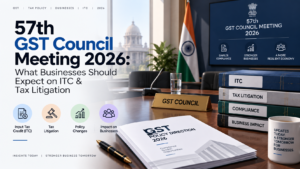
This is important because GST disputes are no longer limited to tax rates.
For many businesses, the bigger concern is whether legitimate Input Tax Credit (ITC) will remain available, what happens when a supplier fails to comply, how blocked credit affects working capital, and whether long-running litigation can be resolved without years of proceedings.
At the same time, businesses should be careful about treating media reports as final law.
The GST Council Secretariat’s meeting notice only establishes the meeting; specific proposals discussed before the meeting are reported expectations and may change. Any recommendation would still require implementation through the appropriate amendments, rules, notifications or circulars.
What Is the 57th GST Council Meeting?
The GST Council is the constitutional body responsible for making recommendations on major GST-related matters, including tax rates, exemptions, principles of levy, place of supply, special provisions and other aspects of GST administration.
The 57th meeting is particularly significant because it comes after the substantial GST rate rationalisation announced at the 56th meeting in September 2025.
The upcoming discussions are expected to shift attention from broad rate restructuring toward compliance simplification, ITC problems, refunds, registration and dispute resolution.
For businesses, that shift could be important.
The next phase of GST reform may be less about changing headline tax rates and more about answering a practical question:
Can compliant businesses claim and use their legitimate GST credits without getting trapped in prolonged disputes?
1. Blocked Input Tax Credit Could Be a Major Focus
One of the biggest expectations from the 57th GST Council Meeting is reconsideration of certain categories of blocked ITC.
Section 17(5) of the CGST Act restricts credit for specified goods and services, subject to prescribed exceptions.
Reported discussions have included easing restrictions in certain areas, including credits connected with motor vehicles and works contracts.
This matters because businesses often incur GST on significant operational expenditure but cannot always utilise the corresponding credit.
For capital-intensive industries, infrastructure businesses, automobile-related businesses and other sectors with substantial taxable expenditure, blocked ITC can directly affect cash flow.
Why Does Blocked ITC Matter?
Suppose a business pays:
₹10 lakh + ₹1.8 lakh GST
If the ₹1.8 lakh GST is eligible as ITC, it can potentially be used against output tax liability.
But if the credit is blocked under the applicable provisions, the GST becomes part of the business’s effective cost.
This can impact:
- Working capital
- Project costs
- Pricing
- Profit margins
- Cash-flow planning
- Investment decisions
Any relaxation therefore could have a direct commercial impact.
2. Supplier Default and the Future of Buyer ITC
One of the most important GST issues businesses are watching is supplier default.
Consider a situation where:
- Buyer receives a genuine invoice
- Goods or services are actually received
- Buyer makes payment
- Buyer maintains proper documentation
- Buyer reports the transaction correctly
- Supplier subsequently fails to comply with GST requirements
The question becomes:
Should a bona fide buyer lose ITC because of the supplier’s subsequent default?
Industry bodies and tax experts have been pushing for greater protection for genuine recipients in such situations. Reports around the upcoming Council meeting indicate that supplier-default-related ITC issues are expected to receive attention.
A possible safe-harbour approach has also been discussed in industry commentary, under which genuine buyers meeting specified conditions could receive greater protection.
However, businesses should not assume that such a safe harbour has already been introduced.
Until an official recommendation and corresponding legal or administrative implementation is issued, existing ITC requirements continue to apply.
3. GST Litigation: Can Long-Running Disputes Be Reduced?
GST litigation has become a significant compliance cost for businesses.
Disputes can arise over:
- ITC eligibility
- Classification
- Valuation
- Place of supply
- Taxability
- Refunds
- Supplier compliance
- Transitional issues
- Interest and penalties
- Interpretation of exemption notifications
- Reverse charge
- Employee-related expenses
- Corporate guarantees
The industry is therefore looking for reforms that reduce unnecessary disputes rather than simply increasing the number of notices and appeals.
Recent industry commentary has specifically highlighted the need to reduce interpretational ambiguity and create mechanisms for resolving or regularising certain legacy tax positions.
4. GSTAT Could Become More Important for Businesses
The operationalisation of the Goods and Services Tax Appellate Tribunal (GSTAT) is another important development for GST dispute resolution.
The GST Council had earlier recommended steps toward operationalising GSTAT, including accepting appeals and commencing hearings, with measures intended to strengthen the institutional framework for GST dispute resolution.
For businesses, a functioning appellate mechanism is significant because prolonged disputes can block:
- Working capital
- ITC
- Refunds
- Business expansion
- Tax provisioning
- Management resources
The broader objective should be to create a more predictable dispute-resolution pathway where taxpayers can challenge disputed demands without remaining stuck in prolonged uncertainty.
5. Refund Rules and Inverted Duty Structure May Get Attention
Another area expected to attract attention is GST refunds.
Businesses operating under an inverted duty structure can accumulate input tax credit because the GST rate on inputs may be higher than the rate applicable to outward supplies.
This can result in substantial accumulation of ITC.
Industry expectations include changes aimed at making the refund mechanism more practical and addressing concerns around the treatment of input services.
For businesses, faster and more predictable refunds can be particularly important for:
- Exporters
- Manufacturers
- Infrastructure businesses
- Pharmaceutical companies
- Textiles
- Engineering businesses
- Service providers
A refund that remains pending for months effectively becomes locked working capital.
6. Compensation Cess Transition and Legacy ITC
Another issue receiving attention is the treatment of credits associated with the transition away from compensation cess.
This is particularly relevant for sectors such as automobiles where businesses may still hold accumulated credit associated with the earlier compensation cess framework.
Industry reports have highlighted concerns around significant accumulated credits and their impact on working capital following the GST 2.0 rate changes.
The key questions for affected businesses include:
Can existing credit be utilised?
Can it be transferred or adjusted?
Will transitional relief be provided?
How will inventory carrying embedded tax costs be treated?
Businesses holding substantial legacy balances should therefore closely monitor the final recommendations and implementation notifications.
7. GST Registration Could Become Easier for Larger Businesses
GST registration is another compliance area expected to be discussed.
Reports indicate that a simplified registration mechanism may be considered for businesses with significant monthly ITC requirements, including businesses claiming tax credit above certain thresholds. A uniform approach for large businesses across central and state administrations has also been reported as an area under development.
For businesses operating across multiple states, registration delays can affect:
- Invoicing
- Vendor onboarding
- ITC
- Supply-chain operations
- Expansion
- Branch operations
Simplifying the process could therefore have a meaningful impact on growing businesses.
8. Corporate Guarantees May Get Further GST Clarity
GST treatment of corporate guarantees has been another area where businesses have faced compliance complexity.
Corporate groups frequently provide guarantees between related entities, particularly where:
- Parent companies support subsidiaries
- Group companies obtain bank facilities
- Businesses raise working capital
- Corporate restructuring takes place
The GST implications around valuation and taxation of such transactions have generated significant discussion.
The 57th Council meeting has been reported as considering simplification in this area.
For corporate groups, any clarification could reduce uncertainty and improve tax planning.
9. Employee-Related Expenses and ITC Could Also See Discussion
Another area reported in connection with the upcoming Council discussions is GST treatment of certain employee-related expenses.
The issue becomes particularly important where companies provide:
- Employee transportation
- Food and catering
- Insurance
- Accommodation
- Other employee welfare benefits
The tax treatment depends on the specific service, statutory requirements, business circumstances and applicable provisions.
Any clarification could help businesses reduce interpretational disputes and create greater certainty around ITC claims.
However, businesses should wait for the final legal position rather than changing their existing tax treatment solely based on pre-meeting expectations.
What Could the 57th GST Council Meeting Mean for ITC?
The potential impact can be summarised as follows:
| Expected Area | Potential Business Impact |
|---|---|
| Blocked ITC | Lower tax cost and improved working capital if restrictions are relaxed |
| Supplier default | Better protection for genuine buyers if safe-harbour rules emerge |
| Refunds | Faster release of blocked working capital |
| Inverted duty | Better utilisation/refund of accumulated ITC |
| Legacy compensation cess | Possible clarity on transitional credit |
| Registration | Faster expansion and onboarding |
| Corporate guarantees | Reduced valuation and compliance uncertainty |
| GSTAT | More structured dispute resolution |
| Litigation | Lower compliance and legal costs if interpretational issues are clarified |
These are potential outcomes and reported expectations, not confirmed GST Council decisions.
What Businesses Should Do Before the 57th GST Council Meeting
Businesses should not wait for the final Council recommendations before reviewing their GST position.
The best approach is to identify where potential reforms could affect your existing exposure.
1. Review Blocked ITC
Prepare a list of credits currently being blocked or disputed under Section 17(5).
Categorise them by:
- Nature of expense
- GST amount
- Business purpose
- Current legal position
- Litigation status
This will make it easier to assess the impact if the rules are relaxed.
2. Reconcile Supplier-Wise ITC
Review whether your major suppliers are:
- Filing GST returns regularly
- Reporting invoices correctly
- Paying tax
- Reflecting invoices appropriately
- Maintaining active GST registration
Supplier compliance should become a regular risk-monitoring exercise.
3. Identify ITC Under Dispute
Create a litigation tracker covering:
- Show cause notices
- Orders
- Appeals
- ITC reversals
- Refund disputes
- Classification disputes
- Valuation disputes
This can help identify matters that may benefit from future clarification or dispute-resolution measures.
4. Review Pending Refunds
Businesses should identify:
- Refund applications pending
- Refunds rejected
- Refunds under appeal
- Accumulated ITC
- Inverted-duty exposure
A proper refund reconciliation can prevent valuable working capital from remaining unnecessarily locked.
5. Review Legacy GST Positions
If your business has unresolved GST matters from earlier periods, document:
- Tax period
- Amount involved
- Section invoked
- Current litigation stage
- Relevant judicial decisions
- Amount already paid
- Potential exposure
This becomes particularly important if any future amnesty or legacy-dispute mechanism is introduced.
What Businesses Should Not Assume Yet
With GST Council meetings, there is often a gap between expectation, recommendation and actual implementation.
Businesses should therefore avoid making immediate accounting or tax-policy changes based only on media reports.
The correct sequence is:
Council discussion → Council recommendation → Notification/legislative amendment/circular → Effective date → Business implementation
This distinction is especially important because the Council’s recommendations are not automatically equivalent to enforceable law.
The official GST Council meeting notice itself states that agenda details were to be communicated separately, while recent reporting has described ITC and litigation issues as expected areas of focus.
How the 57th GST Council Meeting Could Change GST Litigation
The biggest potential shift could be from litigation after disputes arise to compliance mechanisms that prevent disputes from arising in the first place.
For example, if a compliant recipient has:
- Genuine invoice
- Actual receipt of goods/services
- Proper documentation
- Payment through appropriate channels
- Correct reporting
then a predictable framework for dealing with supplier default could reduce unnecessary disputes.
Similarly, clearer rules around:
- Corporate guarantees
- Employee benefits
- Blocked ITC
- Refund calculations
- Registration
- Legacy disputes
could reduce the number of cases reaching appellate authorities.
That would benefit both taxpayers and the tax administration.
GST Compliance Strategy for Businesses in 2026
Regardless of what the Council ultimately recommends, businesses should strengthen their GST controls now.
Monthly GST Control Checklist
ITC Reconciliation
Match purchase register with GSTR-2B and books.
Supplier Risk Monitoring
Identify suppliers with filing or compliance issues.
Blocked Credit Review
Maintain a separate register of Section 17(5) credits.
ITC Ageing
Track credits that remain unutilised or disputed.
Refund Tracking
Maintain application-wise status and supporting documents.
Litigation Tracker
Record notices, orders, appeals and deadlines.
Contract Review
Review GST clauses in vendor and customer contracts.
Related-Party Transactions
Review valuation and documentation for group transactions.
Documentation
Maintain invoices, agreements, proof of receipt and payment records.
Why the 57th GST Council Meeting Matters More Than Just GST Rates
The GST reform conversation is evolving.
Earlier, businesses were primarily focused on:
“What GST rate applies?”
The next stage is increasingly about:
“Can businesses claim, protect and utilise legitimate ITC without unnecessary litigation?”
That is why the 57th GST Council Meeting could be commercially significant even if there is no major headline rate change.
For businesses, a reduction in blocked credit, faster refunds, clearer supplier-default rules and more efficient dispute resolution could potentially create a larger cash-flow benefit than a small rate adjustment.
Final Takeaway
The 57th GST Council Meeting 2026 is expected to focus heavily on the operational challenges businesses continue to face after the broader GST rate rationalisation exercise.
The most important areas to watch include blocked ITC, supplier-default disputes, GST litigation, refunds, inverted-duty issues, compensation cess transition, registration and corporate guarantee taxation.
However, businesses should distinguish between reported expectations and actual GST law.
Until the Council makes recommendations and the government issues the relevant notifications, amendments or circulars, existing GST provisions continue to apply.
The right strategy is therefore not to wait for the meeting.
Businesses should already be reviewing their ITC exposure, supplier compliance, pending refunds, disputed credits and GST litigation so that they can quickly act when the final policy position becomes clear.
For businesses dealing with complex ITC disputes, GST notices, assessments, refunds or litigation, ABSM & Associates can assist with GST advisory, compliance, assessment, appeals and tax dispute management.
Frequently Asked Questions
1. When is the 57th GST Council Meeting 2026?
The 57th GST Council Meeting was originally scheduled for 12 September 2026 but has been rescheduled to 7 October 2026. The change was reported as being linked to a clash with the BRICS Summit in New Delhi.
2. What are the key issues expected to be discussed in the 57th GST Council Meeting?
Reported areas include blocked ITC, supplier-default-related ITC, GST litigation, refunds, inverted-duty issues, registration simplification, corporate guarantees and other compliance challenges. These remain expected discussion areas until officially confirmed.
3. Will the GST Council remove all blocked ITC under Section 17(5)?
There is no confirmed decision to remove all blocked ITC. Reports indicate that easing certain restrictions under Section 17(5) may be considered. Businesses should wait for the final recommendation and implementation before changing their ITC treatment.
4. Will buyers get ITC if their suppliers default on GST?
A potential safe-harbour or protective mechanism for bona fide buyers has been discussed in industry expectations, but there is no basis to treat such a proposal as implemented law until the appropriate official measure is issued.
5. Can the 57th GST Council Meeting reduce GST litigation?
Potentially. Clarifying ITC, refunds, supplier defaults, corporate guarantees and other interpretational issues could reduce disputes. However, the actual impact will depend on the final recommendations and subsequent implementation.
6. Why is GSTAT important for businesses?
The GSTAT provides an important appellate mechanism for resolving GST disputes. Its operationalisation is expected to strengthen the institutional framework for GST dispute resolution and provide taxpayers with another structured avenue for challenging disputed matters.
7. Should businesses change their GST compliance based on expected Council decisions?
No. Businesses should not change their existing GST treatment solely on the basis of media reports or anticipated recommendations. They should wait for the applicable notification, amendment, circular or other legally effective measure.