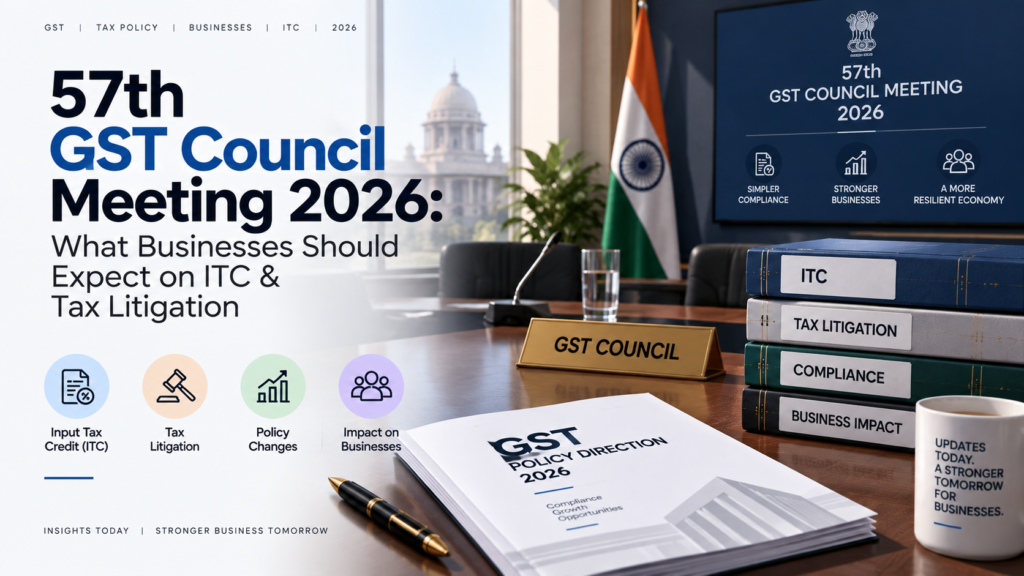
57th GST Council Meeting 2026: What Businesses Should Expect on ITC & Tax Litigation
TL;DR The upcoming 57th GST Council Meeting 2026 could become one of the most important GST policy discussions for businesses dealing with input tax credit, refunds, registration and tax disputes. The meeting was initially scheduled for 12 September 2026, but has now been rescheduled to 7 October 2026. Reports indicate that the Council is expected to focus on operational and compliance issues following the major GST rate rationalisation undertaken in the previous Council meeting. Among the key areas being discussed are blocked input tax credit, supplier defaults, GST litigation, refunds and simplification of registration processes. This is important because GST disputes are no longer limited to tax rates. For many businesses, the bigger concern is whether legitimate Input Tax Credit (ITC) will remain available, what happens when a supplier fails to comply, how blocked credit affects working capital, and whether long-running litigation can be resolved without years of proceedings. At the same time, businesses should be careful about treating media reports as final law. The GST Council Secretariat’s meeting notice only establishes the meeting; specific proposals discussed before the meeting are reported expectations and may change. Any recommendation would still require implementation through the appropriate amendments, rules, notifications or circulars. What Is the 57th GST Council Meeting? The GST Council is the constitutional body responsible for making recommendations on major GST-related matters, including tax rates, exemptions, principles of levy, place of supply, special provisions and other aspects of GST administration. The 57th meeting is particularly significant because it comes after the substantial GST rate rationalisation announced at the 56th meeting in September 2025. The upcoming discussions are expected to shift attention from broad rate restructuring toward compliance simplification, ITC problems, refunds, registration and dispute resolution. For businesses, that shift could be important. The next phase of GST reform may be less about changing headline tax rates and more about answering a practical question: Can compliant businesses claim and use their legitimate GST credits without getting trapped in prolonged disputes? 1. Blocked Input Tax Credit Could Be a Major Focus One of the biggest expectations from the 57th GST Council Meeting is reconsideration of certain categories of blocked ITC. Section 17(5) of the CGST Act restricts credit for specified goods and services, subject to prescribed exceptions. Reported discussions have included easing restrictions in certain areas, including credits connected with motor vehicles and works contracts. This matters because businesses often incur GST on significant operational expenditure but cannot always utilise the corresponding credit. For capital-intensive industries, infrastructure businesses, automobile-related businesses and other sectors with substantial taxable expenditure, blocked ITC can directly affect cash flow. Why Does Blocked ITC Matter? Suppose a business pays: ₹10 lakh + ₹1.8 lakh GST If the ₹1.8 lakh GST is eligible as ITC, it can potentially be used against output tax liability. But if the credit is blocked under the applicable provisions, the GST becomes part of the business’s effective cost. This can impact: Working capital Project costs Pricing Profit margins Cash-flow planning Investment decisions Any relaxation therefore could have a direct commercial impact. 2. Supplier Default and the Future of Buyer ITC One of the most important GST issues businesses are watching is supplier default. Consider a situation where: Buyer receives a genuine invoice Goods or services are actually received Buyer makes payment Buyer maintains proper documentation Buyer reports the transaction correctly Supplier subsequently fails to comply with GST requirements The question becomes: Should a bona fide buyer lose ITC because of the supplier’s subsequent default? Industry bodies and tax experts have been pushing for greater protection for genuine recipients in such situations. Reports around the upcoming Council meeting indicate that supplier-default-related ITC issues are expected to receive attention. A possible safe-harbour approach has also been discussed in industry commentary, under which genuine buyers meeting specified conditions could receive greater protection. However, businesses should not assume that such a safe harbour has already been introduced. Until an official recommendation and corresponding legal or administrative implementation is issued, existing ITC requirements continue to apply. 3. GST Litigation: Can Long-Running Disputes Be Reduced? GST litigation has become a significant compliance cost for businesses. Disputes can arise over: ITC eligibility Classification Valuation Place of supply Taxability Refunds Supplier compliance Transitional issues Interest and penalties Interpretation of exemption notifications Reverse charge Employee-related expenses Corporate guarantees The industry is therefore looking for reforms that reduce unnecessary disputes rather than simply increasing the number of notices and appeals. Recent industry commentary has specifically highlighted the need to reduce interpretational ambiguity and create mechanisms for resolving or regularising certain legacy tax positions. 4. GSTAT Could Become More Important for Businesses The operationalisation of the Goods and Services Tax Appellate Tribunal (GSTAT) is another important development for GST dispute resolution. The GST Council had earlier recommended steps toward operationalising GSTAT, including accepting appeals and commencing hearings, with measures intended to strengthen the institutional framework for GST dispute resolution. For businesses, a functioning appellate mechanism is significant because prolonged disputes can block: Working capital ITC Refunds Business expansion Tax provisioning Management resources The broader objective should be to create a more predictable dispute-resolution pathway where taxpayers can challenge disputed demands without remaining stuck in prolonged uncertainty. 5. Refund Rules and Inverted Duty Structure May Get Attention Another area expected to attract attention is GST refunds. Businesses operating under an inverted duty structure can accumulate input tax credit because the GST rate on inputs may be higher than the rate applicable to outward supplies. This can result in substantial accumulation of ITC. Industry expectations include changes aimed at making the refund mechanism more practical and addressing concerns around the treatment of input services. For businesses, faster and more predictable refunds can be particularly important for: Exporters Manufacturers Infrastructure businesses Pharmaceutical companies Textiles Engineering businesses Service providers A refund that remains pending for months effectively becomes locked working capital. 6. Compensation Cess Transition and Legacy ITC Another issue receiving attention is the treatment of credits associated with the transition away from compensation cess. This is particularly