
TL;DR
MCA compliance is often treated as a routine administrative responsibility: prepare the financial statements, complete the annual return, upload the forms and pay the filing fee.
That approach can become expensive.
A seemingly minor error in an MCA filing can result in resubmission, additional filing fees, penalties, compliance notices or complications with future corporate filings. In more serious situations, prolonged statutory non-compliance can also affect the eligibility of directors.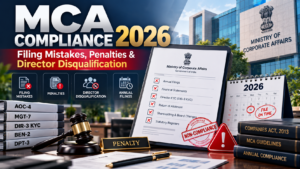
The risk becomes particularly important for companies that repeatedly miss annual filings.
Under Section 164(2) of the Companies Act, 2013, a person who is or has been a director of a company that has not filed its financial statements or annual returns for a continuous period of three financial years can become disqualified for reappointment or appointment in other companies for the prescribed period.
At the same time, MCA’s current V3 environment has continued to evolve. The Ministry states that the final set of company forms, including annual filing forms, is live on the MCA portal. MCA also currently reports more than 21.72 lakh active companies and more than 5.22 lakh active LLPs as of July 31, 2026.
For companies, therefore, MCA compliance in 2026 should be approached as an ongoing governance process rather than a once-a-year formality.
What Is MCA Compliance?
MCA compliance refers to the statutory and regulatory obligations that companies must fulfil with the Ministry of Corporate Affairs and Registrar of Companies under the Companies Act, 2013 and applicable rules.
Depending on the company’s structure and activities, these can include:
- Annual financial statement filing
- Annual return filing
- Board meeting compliance
- AGM compliance
- Director-related filings
- Director KYC
- Auditor-related filings
- Share allotment filings
- Director appointment/resignation filings
- Charge creation or satisfaction filings
- Registered office updates
- Share capital changes
- Related-party transaction compliance
- Deposit-related reporting
- MSME reporting, where applicable
- Statutory registers and records
- Event-based MCA filings
MCA’s corporate-sector filing information includes forms such as AOC-4, MGT-7/MGT-7A, ADT-1, DIR-12, CHG-1, MGT-14, DPT-3 and INC-22, illustrating how broad corporate filing responsibilities can be.
Why MCA Compliance Mistakes Are Becoming More Important in 2026
Companies are increasingly operating in an environment where corporate records, financial information and statutory filings need to remain consistent.
A company may have correct accounting records but still face a compliance issue if:
Books of accounts ≠ Financial statements ≠ MCA filing ≠ Statutory registers
For example, suppose a company has issued additional shares during the year but its shareholding information, statutory registers and MCA filings have not been updated consistently.
The problem may not become visible immediately.
It can surface later during:
- Investor due diligence
- Bank financing
- Fundraising
- Business acquisition
- Tax scrutiny
- Corporate restructuring
- Valuation
- Merger or demerger
- Change in directors
This is why an annual MCA filing should involve a compliance reconciliation, not simply form submission.
12 Common MCA Filing Mistakes Companies Should Avoid in 2026
1. Filing AOC-4 With Incorrect Financial Information
AOC-4 is one of the most important annual ROC filings because it communicates the company’s financial statements and related documents to the Registrar.
A common mistake is preparing the form directly from accounting data without conducting a final reconciliation.
Companies should cross-check:
- Revenue
- Profit/loss
- Paid-up capital
- Reserves
- Borrowings
- Loans and advances
- Related-party transactions
- Fixed assets
- Share capital
- Director information
- Auditor information
- Financial statement attachments
The numbers in the MCA filing should be consistent with the approved financial statements.
AOC-4 and its applicable variants remain part of the MCA annual filing framework.
2. Filing MGT-7 or MGT-7A With Incorrect Shareholding Details
Annual return information is particularly sensitive because it captures the company’s corporate and ownership information.
Mistakes can occur in:
- Number of members
- Shareholding
- Promoters
- Directors
- Share capital
- Transfers
- Meetings
- Indebtedness
- Other prescribed particulars
For companies filing MGT-7A or MGT-7, the applicable form must be selected correctly.
MCA identifies MGT-7A as the annual return form for OPCs and small companies and MGT-7 as the annual return form for companies to which it applies.
3. Missing the Annual Filing Deadline
Late filing is one of the simplest ways to create avoidable compliance costs.
Companies sometimes wait until the last few days before the deadline to upload their annual filings.
This creates multiple risks:
- Portal issues
- DSC problems
- Data validation errors
- Missing attachments
- Professional review delays
- Resubmission
- Additional fees
- Last-minute corrections
The better approach is to prepare the annual compliance package weeks before the statutory deadline.
4. Ignoring Director KYC
Director-related compliance is another area where companies can become non-compliant.
Companies should regularly verify:
- DIN status
- Director’s personal details
- Mobile number
- Email address
- KYC status
- DSC validity
- MCA user profile
MCA has specifically provided guidance around DIR-3 KYC and continues to operate the director-related filing ecosystem through its current portal.
A director’s KYC issue can become especially problematic when the company needs to file another form requiring the director’s authentication.
5. Not Filing DIR-12 After Director Changes
Suppose a director:
- Resigns
- Is appointed
- Is reappointed
- Changes designation
The company’s internal records may be updated, but the corresponding MCA filing must also be reviewed.
DIR-12 is used for reporting particulars of appointment of directors and key managerial personnel and changes among them.
A mismatch between:
Board Resolution → Minutes → Statutory Register → DIR-12 → MCA Master Data
is a common compliance weakness.
6. Forgetting Share Allotment Filings
Companies frequently focus on accounting entries when issuing shares and overlook the corporate filing requirements.
If shares are allotted, the company should review whether the relevant return of allotment and associated compliance have been completed.
This becomes particularly important for startups after:
- Seed investment
- Angel investment
- Rights issue
- Private placement
- Conversion of securities
- Bonus issue
A funding transaction should therefore trigger a corporate compliance checklist, not just an accounting entry.
7. Failing to Register or Update Charges
Where applicable, companies must properly address charges created, modified or satisfied in connection with secured borrowings.
A company may have:
Loan Agreement → Security → Charge → MCA Filing
If the charge-related filing is missed or delayed, the company’s MCA records may not properly reflect its secured obligations.
MCA’s corporate filing framework includes CHG-1 for creation or modification of charges and CHG-4 for satisfaction of charges.
This is particularly important when a company is negotiating new bank facilities or undergoing due diligence.
8. Ignoring MGT-14 Applicability
Certain resolutions and agreements may require filing with the Registrar.
Companies sometimes assume that because a resolution was properly passed internally, no MCA filing is required.
That is not always correct.
The compliance team should review:
- Board resolutions
- Shareholder resolutions
- Special resolutions
- Borrowings
- Corporate restructuring
- Other transactions requiring statutory filing
MGT-14 is among the MCA forms used for filing applicable resolutions and agreements with the Registrar.
9. Missing DPT-3 Applicability
Companies should review amounts received during the relevant period and determine whether DPT-3 reporting applies.
The review should cover:
- Loans
- Advances
- Deposits
- Inter-corporate receipts
- Exempted categories
- Outstanding amounts
DPT-3 is specifically identified within MCA’s corporate filing framework for deposit-related reporting.
The mistake is not simply “forgetting DPT-3.”
The bigger mistake is never performing an applicability assessment.
10. Ignoring MSME-1 Requirements
Companies with eligible outstanding dues to micro or small enterprises should assess whether MSME reporting applies.
The finance team should reconcile:
- Vendor master
- MSME/Udyam information
- Invoice ageing
- Outstanding balances
- Payment dates
The company’s procurement and accounts-payable teams should ideally be involved in this review.
11. Not Updating the Registered Office
The company’s registered-office information should remain accurate in statutory records and MCA filings.
Changes in the registered office can trigger specific compliance requirements.
Companies should not assume that updating the address in:
- GST
- Income Tax
- Bank records
- Website
automatically updates MCA records.
Corporate records must be updated through the applicable MCA process.
MCA identifies INC-22 as the form relating to notice of situation or change of situation of registered office.
12. Treating MCA Compliance as Only an Annual Exercise
This may be the most important mistake.
A company can complete its annual filing correctly and still remain non-compliant during the rest of the year.
Examples include:
- Director resignation
- New director appointment
- Share allotment
- Share capital alteration
- Charge creation
- Registered-office change
- Related-party transactions
- Corporate restructuring
- Changes in auditors
These events can trigger separate compliance requirements.
The right approach is:
Annual Compliance + Event-Based Compliance + Ongoing Record Maintenance
How Filing Mistakes Can Lead to Penalties
The consequences depend on the specific provision violated.
They can include:
- Additional filing fees
- Statutory penalties
- Adjudication proceedings
- Notices from ROC
- Resubmission requirements
- Restrictions or complications in future filings
- Director-level consequences
- Prosecution in applicable cases
- Corporate transaction delays
For example, the statutory framework under Section 137 provides consequences for failure to file financial statements, while Section 92 addresses annual return compliance. Amendments have also changed penalty structures under the Companies Act over time, so businesses should verify the current provision applicable to the particular default rather than relying on outdated penalty figures.
Director Disqualification Under Section 164: What Companies Need to Know
Director disqualification is one of the most serious consequences associated with prolonged company-level non-compliance.
Section 164(2) provides that a person who is or has been a director of a company that:
has not filed financial statements or annual returns for a continuous period of three financial years
can become ineligible for reappointment as a director of that company or appointment as a director in another company for the prescribed five-year period.
The same provision also covers certain prolonged failures relating to repayment of deposits, debentures or payment of declared dividends.
This is why repeated annual filing defaults should never be treated as simply “pending ROC work.”
They can eventually affect the directors themselves.
Director Disqualification vs Penalty: They Are Not the Same
A common misunderstanding is that every late MCA filing automatically disqualifies directors.
That is incorrect.
A late filing may result in:
Additional fee → Penalty/Adjudication → Further regulatory consequences
Director disqualification under Section 164(2) involves specific statutory conditions, including the continuous three-financial-year non-filing condition.
Therefore, companies should distinguish between:
- Late filing
- Additional filing fee
- Penalty
- Adjudication
- Director disqualification
- Vacation of office
These are different legal consequences and should not be treated as interchangeable.
What Happens After Director Disqualification?
When a disqualification arises under the applicable statutory provisions, it can affect the director’s ability to continue or be appointed in companies as provided under the Companies Act.
Section 167 separately deals with vacation of office where a director incurs specified disqualification. The interaction between Sections 164 and 167 has also been considered by the corporate-law framework.
Because director disqualification can have serious consequences, companies should obtain professional advice when dealing with historical defaults rather than attempting to correct multiple years of filings without reviewing the legal position.
MCA V3: Why Filing Accuracy Matters in 2026
MCA’s V3 ecosystem is now central to company filing.
The Ministry states that the final set of 38 company forms, including 13 annual filing forms, went live on the MCA portal, and stakeholders were advised to use the V3 system and associate their DSC appropriately.
This makes preparation even more important.
Before submitting an MCA form, companies should check:
☐ Correct form selected
☐ Correct financial year selected
☐ CIN and company details verified
☐ Director/DIN details verified
☐ DSC valid and associated
☐ Financial figures reconciled
☐ Shareholding reconciled
☐ Statutory registers updated
☐ Mandatory attachments complete
☐ Attachments readable
☐ Dates cross-checked
☐ Previous filings reviewed
☐ Applicable event-based forms completed
☐ Professional certification requirements checked
MCA Compliance Checklist for Private Limited Companies in 2026
Annual Compliance
☐ Financial statements prepared
☐ Financial statements audited where applicable
☐ Board’s Report prepared
☐ AGM conducted
☐ AOC-4 applicability checked
☐ AOC-4 filed within applicable timeline
☐ MGT-7/MGT-7A applicability checked
☐ Annual return filed
☐ Director KYC reviewed
☐ Auditor-related compliance reviewed
Event-Based Compliance
☐ Director appointments reported
☐ Director resignations reported
☐ Share allotments reported
☐ Share capital changes reported
☐ Registered office changes reported
☐ Charges registered/modified/satisfied
☐ Applicable resolutions filed
☐ Auditor changes reported
☐ Other event-based forms reviewed
Internal Corporate Records
☐ Register of Members updated
☐ Register of Directors updated
☐ Register of Charges updated
☐ Share certificates/transfer records maintained
☐ Board minutes maintained
☐ AGM minutes maintained
☐ Related-party records maintained
☐ Loan/investment records maintained
Special Compliance Reviews
☐ MSME-1 applicability assessed
☐ DPT-3 applicability assessed
☐ Related-party transactions reviewed
☐ Loans and guarantees reviewed
☐ Shareholding reconciled
☐ MCA master data checked
☐ Historical defaults reviewed
How to Prevent MCA Filing Mistakes
A strong compliance system should follow a simple process.
Step 1: Maintain a Compliance Calendar
Track every annual and event-based deadline.
Step 2: Assign Responsibility
Every compliance item should have a responsible person.
Step 3: Reconcile Before Filing
Compare:
Books → Financial Statements → Registers → MCA Data
Step 4: Review Historical Filings
Before filing the current year’s forms, check whether previous filings contain inconsistencies.
Step 5: Track Corporate Events
Every major corporate event should automatically trigger a compliance review.
Step 6: Verify DSC and MCA Access
Do not wait until the filing deadline to discover that a director’s DSC has expired or is not properly associated.
Step 7: Maintain Supporting Documents
Keep:
- Board resolutions
- Notices
- Minutes
- Agreements
- Certificates
- Registers
- Financial statements
- Filing acknowledgements
- Challans
- Supporting correspondence
What Companies Should Do If They Have Missed MCA Filings
If a company already has pending MCA compliance, the first step should not be to randomly start filing forms.
Instead, conduct a compliance health check.
Review 1: Identify All Pending Filings
Check annual and event-based filings.
Review 2: Identify the Period of Default
Determine exactly which financial years or events remain non-compliant.
Review 3: Check Director Status
Review whether any director-related consequences have already arisen.
Review 4: Reconcile Corporate Records
Check whether the company’s books, registers and MCA master data agree.
Review 5: Calculate Applicable Fees and Penalties
Determine the current statutory consequences for each default.
Review 6: Create a Regularisation Plan
File outstanding forms in the correct sequence and address any resubmission or adjudication requirements where applicable.
For serious historical defaults, professional legal/company-law advice is advisable before attempting regularisation.
Why Professional MCA Compliance Support Matters
MCA compliance is not simply data entry.
A professional compliance review can help a company identify:
- Missed filings
- Incorrect forms
- Historical defaults
- Director-related issues
- Shareholding inconsistencies
- Charge-related gaps
- MSME/DPT-3 applicability
- Statutory register gaps
- MCA master-data mismatches
- Upcoming compliance deadlines
For growing businesses, this becomes even more important when the company is preparing for:
- Fundraising
- Bank finance
- Investor due diligence
- Business valuation
- M&A
- Restructuring
- Succession planning
- Expansion
MCA Compliance 2026: Final Takeaway
The biggest MCA compliance mistake is assuming that filing a form means the company is compliant.
True compliance requires consistency between:
Corporate Event → Board Approval → Accounting Records → Statutory Registers → MCA Filing → MCA Master Data
A company that systematically tracks its annual and event-based obligations can significantly reduce the risk of avoidable penalties and regulatory complications.
Most importantly, directors should not ignore prolonged annual filing defaults. Section 164(2) specifically addresses continuous non-filing of financial statements or annual returns for three financial years and can have serious consequences for director eligibility.
For companies with historical filing gaps, the priority should be a structured compliance review followed by a legally appropriate regularisation strategy.
ABSM & Associates can support businesses with corporate compliance, regulatory advisory, taxation, audit, startup advisory and broader financial and legal compliance requirements, helping companies maintain accurate records and manage statutory obligations more systematically.
Frequently Asked Questions
What are the most common MCA filing mistakes in 2026?
Common mistakes include incorrect financial information in AOC-4, incorrect shareholding information in annual returns, missed filing deadlines, incomplete attachments, incorrect director details, failure to report corporate events and ignoring event-based filings.
Can late MCA filing lead to director disqualification?
Not every late filing results in director disqualification. However, Section 164(2) provides for disqualification where a company has not filed its financial statements or annual returns for a continuous period of three financial years, subject to the statutory provisions.
How many years of non-filing can result in director disqualification?
Section 164(2) refers to non-filing of financial statements or annual returns for a continuous period of three financial years. The resulting consequences should be evaluated based on the specific facts and applicable law.
What is the difference between ROC penalty and director disqualification?
An ROC penalty is a financial or regulatory consequence for a statutory default. Director disqualification is a separate statutory consequence that can affect a person’s eligibility to be appointed or reappointed as a director.
Is AOC-4 an annual MCA filing?
Yes. AOC-4 is used for filing financial statements and related documents with the Registrar, subject to the applicable provisions and form variant.
Is MGT-7 mandatory for every company?
The applicable annual return form depends on the company’s classification. MGT-7 and MGT-7A have different applicability, so companies should select the correct form based on their statutory status.
What is DIR-12 used for?
DIR-12 is used to report particulars relating to appointment of directors and key managerial personnel and changes among them.
Can a company correct old MCA filing mistakes?
Depending on the nature of the error, correction or regularisation may be possible through the applicable MCA mechanism. The appropriate approach depends on the form, error, filing status and relevant statutory provisions.
What should a company do if it has several years of pending MCA filings?
The company should first conduct a complete compliance health check covering all pending filings, historical defaults, director status, statutory records and MCA master data. A regularisation strategy should then be prepared based on the specific defaults.
For ROC and MCA filings, see our Regulatory Compliances in Jaipur service.