MCA Compliance 2026: Common Filing Mistakes That Can Lead to Penalties & Director Disqualification
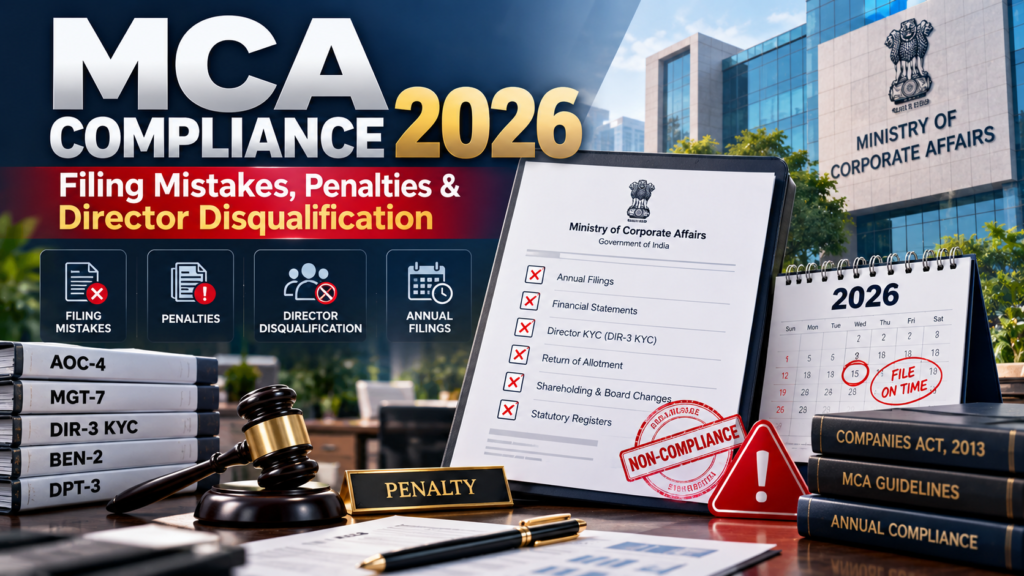
TL;DR MCA compliance is often treated as a routine administrative responsibility: prepare the financial statements, complete the annual return, upload the forms and pay the filing fee. That approach can become expensive. A seemingly minor error in an MCA filing can result in resubmission, additional filing fees, penalties, compliance notices or complications with future corporate filings. In more serious situations, prolonged statutory non-compliance can also affect the eligibility of directors. The risk becomes particularly important for companies that repeatedly miss annual filings. Under Section 164(2) of the Companies Act, 2013, a person who is or has been a director of a company that has not filed its financial statements or annual returns for a continuous period of three financial years can become disqualified for reappointment or appointment in other companies for the prescribed period. At the same time, MCA’s current V3 environment has continued to evolve. The Ministry states that the final set of company forms, including annual filing forms, is live on the MCA portal. MCA also currently reports more than 21.72 lakh active companies and more than 5.22 lakh active LLPs as of July 31, 2026. For companies, therefore, MCA compliance in 2026 should be approached as an ongoing governance process rather than a once-a-year formality. What Is MCA Compliance? MCA compliance refers to the statutory and regulatory obligations that companies must fulfil with the Ministry of Corporate Affairs and Registrar of Companies under the Companies Act, 2013 and applicable rules. Depending on the company’s structure and activities, these can include: Annual financial statement filing Annual return filing Board meeting compliance AGM compliance Director-related filings Director KYC Auditor-related filings Share allotment filings Director appointment/resignation filings Charge creation or satisfaction filings Registered office updates Share capital changes Related-party transaction compliance Deposit-related reporting MSME reporting, where applicable Statutory registers and records Event-based MCA filings MCA’s corporate-sector filing information includes forms such as AOC-4, MGT-7/MGT-7A, ADT-1, DIR-12, CHG-1, MGT-14, DPT-3 and INC-22, illustrating how broad corporate filing responsibilities can be. Why MCA Compliance Mistakes Are Becoming More Important in 2026 Companies are increasingly operating in an environment where corporate records, financial information and statutory filings need to remain consistent. A company may have correct accounting records but still face a compliance issue if: Books of accounts ≠ Financial statements ≠ MCA filing ≠ Statutory registers For example, suppose a company has issued additional shares during the year but its shareholding information, statutory registers and MCA filings have not been updated consistently. The problem may not become visible immediately. It can surface later during: Investor due diligence Bank financing Fundraising Business acquisition Tax scrutiny Corporate restructuring Valuation Merger or demerger Change in directors This is why an annual MCA filing should involve a compliance reconciliation, not simply form submission. 12 Common MCA Filing Mistakes Companies Should Avoid in 2026 1. Filing AOC-4 With Incorrect Financial Information AOC-4 is one of the most important annual ROC filings because it communicates the company’s financial statements and related documents to the Registrar. A common mistake is preparing the form directly from accounting data without conducting a final reconciliation. Companies should cross-check: Revenue Profit/loss Paid-up capital Reserves Borrowings Loans and advances Related-party transactions Fixed assets Share capital Director information Auditor information Financial statement attachments The numbers in the MCA filing should be consistent with the approved financial statements. AOC-4 and its applicable variants remain part of the MCA annual filing framework. 2. Filing MGT-7 or MGT-7A With Incorrect Shareholding Details Annual return information is particularly sensitive because it captures the company’s corporate and ownership information. Mistakes can occur in: Number of members Shareholding Promoters Directors Share capital Transfers Meetings Indebtedness Other prescribed particulars For companies filing MGT-7A or MGT-7, the applicable form must be selected correctly. MCA identifies MGT-7A as the annual return form for OPCs and small companies and MGT-7 as the annual return form for companies to which it applies. 3. Missing the Annual Filing Deadline Late filing is one of the simplest ways to create avoidable compliance costs. Companies sometimes wait until the last few days before the deadline to upload their annual filings. This creates multiple risks: Portal issues DSC problems Data validation errors Missing attachments Professional review delays Resubmission Additional fees Last-minute corrections The better approach is to prepare the annual compliance package weeks before the statutory deadline. 4. Ignoring Director KYC Director-related compliance is another area where companies can become non-compliant. Companies should regularly verify: DIN status Director’s personal details Mobile number Email address KYC status DSC validity MCA user profile MCA has specifically provided guidance around DIR-3 KYC and continues to operate the director-related filing ecosystem through its current portal. A director’s KYC issue can become especially problematic when the company needs to file another form requiring the director’s authentication. 5. Not Filing DIR-12 After Director Changes Suppose a director: Resigns Is appointed Is reappointed Changes designation The company’s internal records may be updated, but the corresponding MCA filing must also be reviewed. DIR-12 is used for reporting particulars of appointment of directors and key managerial personnel and changes among them. A mismatch between: Board Resolution → Minutes → Statutory Register → DIR-12 → MCA Master Data is a common compliance weakness. 6. Forgetting Share Allotment Filings Companies frequently focus on accounting entries when issuing shares and overlook the corporate filing requirements. If shares are allotted, the company should review whether the relevant return of allotment and associated compliance have been completed. This becomes particularly important for startups after: Seed investment Angel investment Rights issue Private placement Conversion of securities Bonus issue A funding transaction should therefore trigger a corporate compliance checklist, not just an accounting entry. 7. Failing to Register or Update Charges Where applicable, companies must properly address charges created, modified or satisfied in connection with secured borrowings. A company may have: Loan Agreement → Security → Charge → MCA Filing If the charge-related filing is missed or delayed, the company’s MCA records may not properly reflect its secured obligations. MCA’s corporate filing framework includes CHG-1