
TL;DR
A recent ITAT Bangalore ruling has provided important relief to a taxpayer whose income-tax return was processed under the old tax regime because of an error by the tax consultant, despite the taxpayer intending to be taxed under the new regime.
According to reports on the ruling, the taxpayer had declared income of about ₹32.55 lakh and intended to use the new tax regime. However, Form 10-IEA was mistakenly filed, causing the return to be processed under the old regime and resulting in a tax demand of approximately ₹1.23 lakh. The ITAT directed that the return be processed under the new regime in the circumstances of the case.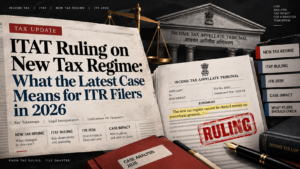
The case is important because it shows that a genuine tax-regime selection error does not necessarily mean a taxpayer has no remedy. However, the ruling should not be interpreted as giving every taxpayer an automatic right to switch regimes after missing a statutory requirement. ITAT decisions are fact-specific, and taxpayers should distinguish the assessment year involved and the law applicable to that year.
For Tax Year 2026–27, the Income Tax Act, 2025 introduces the new tax regime under Section 202, and the Income Tax Department confirms that the new regime remains the default regime. It also confirms that an option exercised under the old Act can transition into the equivalent provision under the new Act.
Introduction
Choosing between the old and new tax regimes may look like a routine step while filing an Income Tax Return.
But a recent ITAT ruling shows how a seemingly small filing mistake can create a significant tax demand.
In the case reported from the Bangalore ITAT, the taxpayer intended to be assessed under the new tax regime. However, an error during the filing process resulted in the wrong treatment of the regime, leading to an additional tax demand of around ₹1.23 lakh.
The ITAT ultimately granted relief in the specific circumstances of the case.
The ruling is particularly relevant in 2026 because India’s income-tax framework has entered a major transition.
The Income Tax Act, 2025 came into force from 1 April 2026, and the new tax regime is now provided under Section 202, replacing the earlier Section 115BAC framework for tax years governed by the new Act. The Income Tax Department confirms that the new regime continues as the default regime.
At the same time, taxpayers filing returns for AY 2026–27 are still dealing with the Income Tax Act, 1961 because that return relates to income earned during FY 2025–26.
That makes understanding this ITAT ruling—and the distinction between old-law and new-law returns—especially important.
What Happened in the Latest ITAT Case?
The case involved a taxpayer from Bengaluru who had intended to file his return under the new tax regime.
The taxpayer declared income of approximately ₹32.55 lakh.
However, according to reports, a mistake by the tax consultant resulted in Form 10-IEA being submitted in a manner that caused the return to be treated under the old tax regime.
The resulting computation generated a tax demand of approximately ₹1.23 lakh.
The taxpayer challenged the treatment and the matter eventually reached the Income Tax Appellate Tribunal.
The ITAT considered the circumstances and directed that the return be processed under the new regime, effectively providing relief from the additional demand caused by the filing error.
Why is this ruling important?
Because it addresses a very practical problem:
What happens when a taxpayer’s actual intention is to choose the new regime, but an error in filing causes the return to be processed under the old regime?
The ruling suggests that genuine procedural or clerical mistakes can be examined on their facts rather than automatically resulting in permanent denial of the taxpayer’s intended tax treatment.
But there is an important caveat.
This does not mean taxpayers can ignore filing deadlines or assume that every regime-selection mistake will be corrected by ITAT.
The exact facts, applicable assessment year, statutory requirements and evidence of the taxpayer’s intention all matter.
Why Did Form 10-IEA Matter?
For certain taxpayers under the old Income Tax Act framework, opting out of the default new tax regime involved filing the prescribed form within the applicable deadline.
This created an important distinction between:
Choosing the new regime
and
Choosing the old regime by opting out of the new regime.
Form 10-IEA became relevant for taxpayers who wanted to exercise the option to opt out of the default new regime in applicable cases.
This is why mistakes involving Form 10-IEA could have a direct impact on the tax computation.
The recent ITAT case demonstrates how an incorrect form or filing action can potentially cause the tax system to calculate liability under a different regime from the one the taxpayer intended.
What Has Changed Under the Income Tax Act, 2025?
This is where 2026 ITR filers need to be particularly careful.
The Income Tax Act, 2025 came into force from 1 April 2026.
Under the new Act, the new tax regime is provided under Section 202.
The Income Tax Department specifically confirms that:
- The new tax regime continues under the new Act.
- It remains the default regime.
- Eligible taxpayers can opt out and choose the old regime subject to the applicable conditions.
- An option exercised under the old Act is treated as having been made under the equivalent provision of the new Act.
This is a significant transition point for taxpayers.
Form 10-IEA Is No Longer Required Under the New Act
One of the most important practical differences for taxpayers in 2026 is that Form 10-IEA is no longer required under the Income Tax Act, 2025.
This is particularly relevant for taxpayers filing returns relating to Tax Year 2026–27 and subsequent tax years.
The new Act has simplified the process around regime selection compared with the earlier framework.
Therefore, taxpayers should not automatically carry forward the old Form 10-IEA process into new-Act tax years.
But what about AY 2026–27?
This is where taxpayers can easily become confused.
AY 2026–27 relates to income earned during FY 2025–26.
That period is governed by the Income Tax Act, 1961.
The Income Tax Department confirms that returns for AY 2026–27 continue to be filed under the old Act, even though the new Act came into force from 1 April 2026.
So:
| Return / Income Period | Applicable Framework |
|---|---|
| FY 2025–26 | Income Tax Act, 1961 |
| AY 2026–27 | Income Tax Act, 1961 |
| FY 2026–27 | Income Tax Act, 2025 |
| Tax Year 2026–27 | Income Tax Act, 2025 |
| Form 10-IEA for new Act Tax Year | Not required |
This distinction is essential for accurate 2026 tax content.
What Does the ITAT Ruling Actually Mean for ITR Filers?
The biggest takeaway is not simply:
“You can choose the new regime even after making a mistake.”
The more accurate takeaway is:
A genuine filing error may be capable of correction or relief where the taxpayer can demonstrate the actual intention and the surrounding facts support the claim.
This matters because tax filing is increasingly digital.
A taxpayer can make an error through:
- Wrong tax-regime selection
- Incorrect form submission
- Incorrect ITR utility selection
- Consultant error
- Portal-related issues
- Incorrect reporting
- Failure to correctly communicate the intended regime
A resulting tax demand may therefore not always reflect the taxpayer’s actual intended tax position.
Can Everyone Claim the New Tax Regime After Filing Under the Old Regime?
No.
This is one of the most important points to understand.
An ITAT decision cannot be treated as a blanket exemption from statutory conditions.
Whether a taxpayer can change or claim a regime depends on factors such as:
- Assessment Year or Tax Year
- Nature of income
- Whether the taxpayer has business/professional income
- Whether the return was filed within the applicable deadline
- Whether the relevant option was validly exercised
- Whether required forms were filed
- Whether the error was genuine
- Evidence available to establish the taxpayer’s intention
- The specific legal provisions applicable to that year
The recent ruling is therefore best understood as fact-specific judicial relief, not a universal relaxation.
New Tax Regime Under Section 202 of the Income Tax Act, 2025
For tax years governed by the new Act, the new tax regime is contained in Section 202.
The Income Tax Department confirms that the new regime remains the default regime for eligible taxpayers and that taxpayers can opt out subject to the applicable provisions.
This means that taxpayers should understand the regime-selection process before filing the return rather than assuming that the old regime is automatically selected.
Basic framework
Default: New tax regime
Alternative: Old tax regime, where the taxpayer is eligible and exercises the applicable option
For Tax Year 2026–27: New Income Tax Act, 2025 applies
For AY 2026–27: Old Income Tax Act, 1961 applies
New Tax Regime vs Old Tax Regime
The difference between the two regimes is not simply about which one has lower tax rates.
The old regime generally provides access to a wider range of deductions and exemptions, while the new regime generally provides concessional slab rates with fewer deductions.
For a taxpayer, the correct choice depends on the individual’s income structure and eligible deductions.
Factors to compare
| Factor | Old Tax Regime | New Tax Regime |
|---|---|---|
| Tax rates | Higher in many income ranges | Concessional structure |
| Standard deduction | Available subject to rules | Available subject to rules |
| Section 80C-type deductions | Generally available subject to eligibility | Generally restricted |
| HRA exemption | Potentially available | Generally not available |
| Home-loan interest | Certain benefits available subject to conditions | Restrictions apply |
| Tax regime selection | Requires applicable option | Default regime |
| Best for | Taxpayers with significant eligible deductions | Taxpayers seeking simpler/concessional structure |
The exact tax outcome should always be calculated using the provisions applicable to the relevant Tax Year or Assessment Year.
Why ITR Filers Should Not Blindly Follow Old Tax Advice in 2026
The transition to the Income Tax Act, 2025 creates a major risk of outdated advice.
A blog published under the old law may say:
“File Form 10-IEA to select your tax regime.”
That instruction cannot simply be applied to a return governed by the Income Tax Act, 2025.
Similarly, an old article may refer to:
Section 115BAC
while a taxpayer dealing with the new Act needs to understand:
Section 202
The underlying tax-regime concept continues, but the statutory framework and section references have changed.
The Income Tax Department itself confirms that the old and new Acts operate in parallel for different tax years during the transition.
What If Your ITR Was Processed Under the Wrong Tax Regime?
If your return has already been processed under the wrong regime, do not immediately assume that the tax demand is final.
First, identify why the mismatch occurred.
Step 1: Check the filed ITR
Review the copy of the return that was actually submitted.
Step 2: Check the regime selected
Determine whether the ITR itself reflects the old or new regime.
Step 3: Check relevant forms
For returns governed by the old Act, check whether the applicable Form 10-IE/10-IEA requirement was correctly handled.
Step 4: Compare the tax computation
Calculate the difference between:
Tax under intended regime
and
Tax under regime used for processing
Step 5: Check the 143(1) intimation
Review the processing intimation and identify the reason for the additional demand.
Step 6: Preserve evidence
Keep:
- ITR acknowledgement
- Computation
- Form submissions
- Tax-payment challans
- Emails with tax consultant
- Working papers
- Screenshots where relevant
- Communication showing the taxpayer’s intended regime
Step 7: Consider the appropriate remedy
Depending on the facts and stage of the matter, the taxpayer may need to consider:
- Rectification
- Response to outstanding demand
- Appeal
- Other statutory remedies
A tax professional should examine the exact facts before selecting the remedy.
What Evidence Can Help Prove Your Intended Tax Regime?
In a dispute involving a filing mistake, documentation can become extremely important.
Useful evidence may include:
Tax computation prepared before filing
If the computation clearly shows the new regime, it can help establish the taxpayer’s intention.
Emails or instructions to the tax consultant
Written instructions can be particularly useful where the error occurred during professional filing.
Previous-year tax treatment
A taxpayer’s history of selecting the new regime may provide relevant factual context, although it does not by itself determine the outcome.
Tax-planning documents
Investment and deduction calculations prepared before filing can sometimes demonstrate why a particular regime was selected.
Filed forms and acknowledgements
Keep copies of all forms submitted through the portal.
A Similar Pattern Has Appeared in Earlier ITAT Decisions
The latest ruling is not completely isolated.
Several ITAT decisions have dealt with disputes over delayed or incorrect exercise of the new-regime option under Section 115BAC of the old Act.
For example, in Sambaiah Dara v. ITO, the Hyderabad ITAT considered whether delayed filing of Form 10-IE should automatically invalidate the taxpayer’s claim to the new regime. The Tribunal referred to earlier decisions and held, on the facts before it, that failure to file the form within the prescribed time did not necessarily invalidate the substantive option.
Similarly, the Pune ITAT in Balshiram Dattatray Thorat v. ITO considered continuation of an earlier valid option under Section 115BAC and found that the taxpayer’s new-regime option should not have been denied in the circumstances of that case.
Another 2026 decision in Seema Kulkarni v. ITO also examined the distinction between the substantive validity of the new-regime option and the procedural requirement surrounding Form 10-IE.
These cases collectively show why taxpayers should distinguish between:
Substantive eligibility
and
Procedural compliance.
But because ITAT decisions are fact-specific and may be subject to further appeal, they should not be treated as universal statutory rules.
What Is the Biggest Lesson for ITR Filers in 2026?
The biggest lesson is simple:
Tax-regime selection should be treated as a compliance decision, not a last-minute checkbox.
Before filing your ITR, calculate both scenarios.
Example
Suppose a taxpayer has:
- Salary: ₹18 lakh
- Interest income: ₹1 lakh
- Other income: ₹50,000
- Eligible deductions under the old regime: ₹2.5 lakh
The taxpayer should calculate:
Tax under old regime
versus
Tax under new regime
The lower-tax option is not automatically the correct option if the taxpayer does not satisfy the applicable conditions.
A proper comparison should consider:
- Total income
- Deductions
- Exemptions
- Tax slabs
- Rebate
- Surcharge
- Cess
- Employer benefits
- Business/professional income
- Regime-switching restrictions
Business and Professional Taxpayers Need Extra Caution
The regime-selection rules can become more complicated for taxpayers who have income from business or profession.
Unlike many salaried/non-business taxpayers, individuals and HUFs with business or professional income can face additional conditions around exercising and withdrawing the option.
Therefore, a freelancer, consultant, doctor, lawyer, architect or business owner should not assume that the regime can be changed as freely as a salaried taxpayer can change it.
The Income Tax Department’s current guidance distinguishes between taxpayers with and without business/professional income when explaining regime selection.
2026 ITR Regime-Selection Checklist
Before submitting your return, check:
☑ Identify whether you are filing AY 2026–27 or Tax Year 2026–27
☑ Confirm which Income Tax Act applies
☑ Calculate tax under both regimes where relevant
☑ Review deductions and exemptions
☑ Check salary TDS
☑ Check Form 16
☑ Reconcile AIS and Form 26AS
☑ Review capital gains
☑ Check interest and dividend income
☑ Confirm regime selection in the ITR
☑ Verify applicable forms for the relevant year
☑ Download and preserve the filed ITR
☑ Preserve computation and supporting documents
☑ Verify the 143(1) intimation after processing
What This Means for AY 2026–27 Filers
Taxpayers filing AY 2026–27 should be particularly careful because this return is still governed by the Income Tax Act, 1961.
That means the new Income Tax Act does not retroactively change the law applicable to FY 2025–26 income.
The Income Tax Department explicitly states that AY 2026–27 returns filed in 2026 will use forms prescribed under the old Act. At the same time, advance-tax payments for Tax Year 2026–27 are made under the new Act.
This creates a period where taxpayers may encounter:
Old Act for ITR filing + New Act for current-year advance tax.
That distinction should be clearly understood by taxpayers and tax professionals.
What This Means for Tax Year 2026–27 Filers
For income earned from 1 April 2026 to 31 March 2027, the new Income Tax Act, 2025 applies.
The new regime is provided under Section 202.
The Income Tax Department confirms that a taxpayer who had already exercised an option under the old Act does not necessarily need to treat it as a completely new election because the earlier option is recognised under the corresponding provision of the new Act.
This is one of the transition provisions that makes understanding the new Act particularly important.
Common Mistakes to Avoid in 2026
1. Assuming every 2026 ITR is governed by the new Act
AY 2026–27 remains under the old Act.
2. Using outdated Form 10-IEA instructions
The form requirement should be checked against the specific tax year and applicable law.
3. Selecting a regime without comparing tax liability
A taxpayer should calculate both regimes where applicable.
4. Ignoring business-income restrictions
Business and professional taxpayers have different regime-switching rules.
5. Assuming an ITAT ruling guarantees relief
Judicial decisions depend on facts and applicable law.
6. Not checking the processed ITR
A taxpayer should review the 143(1) intimation after processing.
7. Ignoring small filing errors
A wrong selection or form can create a significant tax difference.
Frequently Asked Questions
1. What is the latest ITAT ruling on the new tax regime in 2026?
A recent Bangalore ITAT matter involved a taxpayer whose return was processed under the old regime because of a filing error, despite the taxpayer’s intention to use the new regime. The Tribunal directed relief in the circumstances of that case.
2. Does the ITAT ruling mean everyone can switch to the new tax regime after filing?
No. The ruling is fact-specific. Taxpayers must satisfy the applicable statutory requirements for their Assessment Year or Tax Year.
3. Is Form 10-IEA required in 2026?
For tax years governed by the Income Tax Act, 2025, Form 10-IEA is no longer required. However, taxpayers filing returns under the old Act, such as AY 2026–27, must follow the rules applicable to that assessment year.
4. What is the new tax regime section under the Income Tax Act, 2025?
The new tax regime is provided under Section 202 of the Income Tax Act, 2025.
5. Does the new tax regime continue under the Income Tax Act, 2025?
Yes. The Income Tax Department confirms that the new regime continues and remains the default regime for eligible taxpayers.
6. What is the difference between AY 2026–27 and Tax Year 2026–27?
AY 2026–27 relates to income earned during FY 2025–26 and remains governed by the Income Tax Act, 1961. Tax Year 2026–27 covers income earned from 1 April 2026 to 31 March 2027 and is governed by the Income Tax Act, 2025.
7. Can a salaried taxpayer change the tax regime every year?
For taxpayers without business or professional income, the applicable regime-selection rules generally allow the taxpayer to choose between the regimes each year, subject to the applicable filing requirements and deadline.
8. What should I do if my ITR was processed under the wrong tax regime?
First review the filed ITR, the regime selected, relevant forms and the 143(1) intimation. Depending on the circumstances, rectification or appeal may be available. Professional review is advisable before taking action.
9. Does an ITAT ruling automatically apply to all taxpayers?
No. ITAT decisions are generally based on the facts, law and arguments in the particular case. They can be persuasive in similar matters but should not be treated as automatic statutory exemptions.
10. Why is this ruling important for ITR filers in 2026?
It highlights the importance of accurately selecting the tax regime and checking the return before submission. It also shows that genuine procedural mistakes may have remedies where the facts support the taxpayer’s position.
Conclusion
The latest ITAT ruling on the new tax regime provides an important practical lesson for taxpayers filing income-tax returns in 2026.
A filing mistake can have a real financial impact. In the reported Bangalore case, an error involving the filing process caused the taxpayer’s return to be processed under the old regime and resulted in an additional demand of approximately ₹1.23 lakh. The ITAT ultimately granted relief in the circumstances of the case.
But taxpayers should not interpret the ruling as a licence to ignore deadlines or statutory requirements.
The more important lesson is to choose the tax regime carefully, verify the ITR before submission, preserve evidence and check the processing intimation afterward.
The transition to the Income Tax Act, 2025 makes this even more important.
For AY 2026–27, the old Income Tax Act, 1961 remains relevant. For Tax Year 2026–27, the new Act applies and the new tax regime is contained in Section 202. The Income Tax Department also confirms that the old and new Acts operate in parallel for their respective periods during the transition.
For taxpayers with complex income, business or professional income, significant deductions, capital gains or an existing tax dispute, professional review can help ensure that the selected regime and filing approach are consistent with the applicable law.
ABSM & Associates can assist with income-tax return filing, tax-regime comparison, tax planning, assessments, scrutiny proceedings, appeals and compliance under the Income Tax Act, 2025.
BLOG BY: ABSM & ASSOCIATES
Need help with an income tax notice or assessment? See our E-Assessment & Scrutiny Handling service.