ITAT Ruling on New Tax Regime: What the Latest Case Means for ITR Filers in 2026
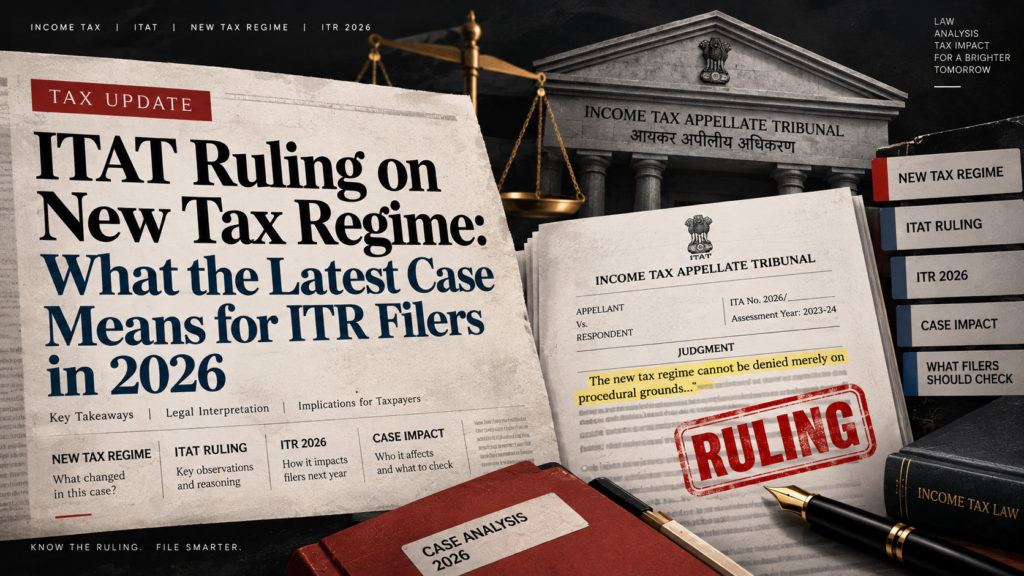
TL;DR A recent ITAT Bangalore ruling has provided important relief to a taxpayer whose income-tax return was processed under the old tax regime because of an error by the tax consultant, despite the taxpayer intending to be taxed under the new regime. According to reports on the ruling, the taxpayer had declared income of about ₹32.55 lakh and intended to use the new tax regime. However, Form 10-IEA was mistakenly filed, causing the return to be processed under the old regime and resulting in a tax demand of approximately ₹1.23 lakh. The ITAT directed that the return be processed under the new regime in the circumstances of the case. The case is important because it shows that a genuine tax-regime selection error does not necessarily mean a taxpayer has no remedy. However, the ruling should not be interpreted as giving every taxpayer an automatic right to switch regimes after missing a statutory requirement. ITAT decisions are fact-specific, and taxpayers should distinguish the assessment year involved and the law applicable to that year. For Tax Year 2026–27, the Income Tax Act, 2025 introduces the new tax regime under Section 202, and the Income Tax Department confirms that the new regime remains the default regime. It also confirms that an option exercised under the old Act can transition into the equivalent provision under the new Act. Introduction Choosing between the old and new tax regimes may look like a routine step while filing an Income Tax Return. But a recent ITAT ruling shows how a seemingly small filing mistake can create a significant tax demand. In the case reported from the Bangalore ITAT, the taxpayer intended to be assessed under the new tax regime. However, an error during the filing process resulted in the wrong treatment of the regime, leading to an additional tax demand of around ₹1.23 lakh. The ITAT ultimately granted relief in the specific circumstances of the case. The ruling is particularly relevant in 2026 because India’s income-tax framework has entered a major transition. The Income Tax Act, 2025 came into force from 1 April 2026, and the new tax regime is now provided under Section 202, replacing the earlier Section 115BAC framework for tax years governed by the new Act. The Income Tax Department confirms that the new regime continues as the default regime. At the same time, taxpayers filing returns for AY 2026–27 are still dealing with the Income Tax Act, 1961 because that return relates to income earned during FY 2025–26. That makes understanding this ITAT ruling—and the distinction between old-law and new-law returns—especially important. What Happened in the Latest ITAT Case? The case involved a taxpayer from Bengaluru who had intended to file his return under the new tax regime. The taxpayer declared income of approximately ₹32.55 lakh. However, according to reports, a mistake by the tax consultant resulted in Form 10-IEA being submitted in a manner that caused the return to be treated under the old tax regime. The resulting computation generated a tax demand of approximately ₹1.23 lakh. The taxpayer challenged the treatment and the matter eventually reached the Income Tax Appellate Tribunal. The ITAT considered the circumstances and directed that the return be processed under the new regime, effectively providing relief from the additional demand caused by the filing error. Why is this ruling important? Because it addresses a very practical problem: What happens when a taxpayer’s actual intention is to choose the new regime, but an error in filing causes the return to be processed under the old regime? The ruling suggests that genuine procedural or clerical mistakes can be examined on their facts rather than automatically resulting in permanent denial of the taxpayer’s intended tax treatment. But there is an important caveat. This does not mean taxpayers can ignore filing deadlines or assume that every regime-selection mistake will be corrected by ITAT. The exact facts, applicable assessment year, statutory requirements and evidence of the taxpayer’s intention all matter. Why Did Form 10-IEA Matter? For certain taxpayers under the old Income Tax Act framework, opting out of the default new tax regime involved filing the prescribed form within the applicable deadline. This created an important distinction between: Choosing the new regime and Choosing the old regime by opting out of the new regime. Form 10-IEA became relevant for taxpayers who wanted to exercise the option to opt out of the default new regime in applicable cases. This is why mistakes involving Form 10-IEA could have a direct impact on the tax computation. The recent ITAT case demonstrates how an incorrect form or filing action can potentially cause the tax system to calculate liability under a different regime from the one the taxpayer intended. What Has Changed Under the Income Tax Act, 2025? This is where 2026 ITR filers need to be particularly careful. The Income Tax Act, 2025 came into force from 1 April 2026. Under the new Act, the new tax regime is provided under Section 202. The Income Tax Department specifically confirms that: The new tax regime continues under the new Act. It remains the default regime. Eligible taxpayers can opt out and choose the old regime subject to the applicable conditions. An option exercised under the old Act is treated as having been made under the equivalent provision of the new Act. This is a significant transition point for taxpayers. Form 10-IEA Is No Longer Required Under the New Act One of the most important practical differences for taxpayers in 2026 is that Form 10-IEA is no longer required under the Income Tax Act, 2025. This is particularly relevant for taxpayers filing returns relating to Tax Year 2026–27 and subsequent tax years. The new Act has simplified the process around regime selection compared with the earlier framework. Therefore, taxpayers should not automatically carry forward the old Form 10-IEA process into new-Act tax years. But what about AY 2026–27? This is where taxpayers can easily become confused. AY 2026–27 relates to income earned during FY 2025–26. That period