
Company Incorporation in 2026: Private Limited Company vs LLP – Which Structure Is Better?
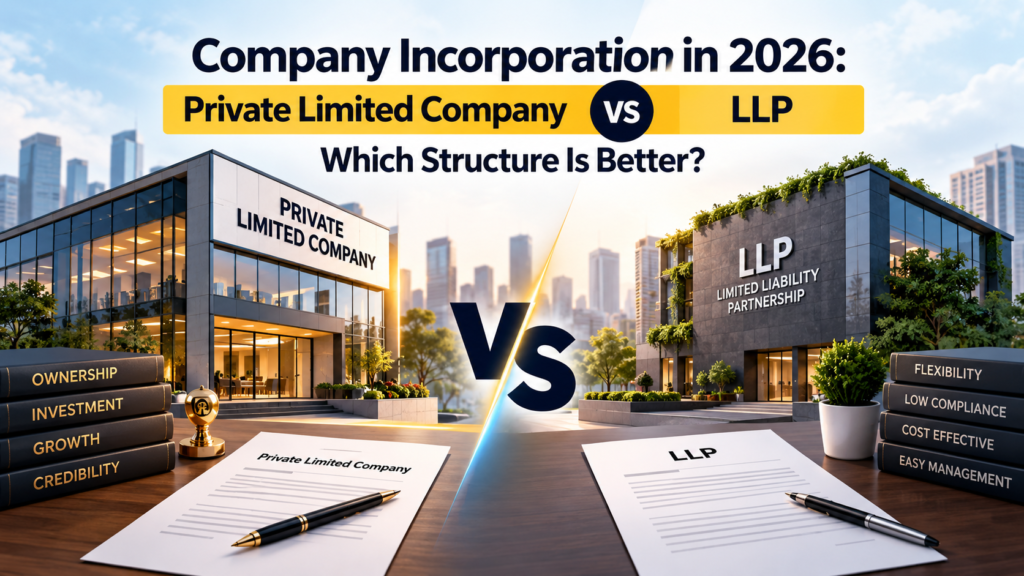
TL;DR Introduction Choosing the right legal structure is one of the most important decisions when starting a business in India. In 2026, entrepreneurs commonly compare two structures: a Private Limited Company and a Limited Liability Partnership (LLP). Both provide limited liability protection and create a separate legal structure for carrying on business, but they are designed for different types of businesses. A startup planning to raise venture capital may have very different requirements from a professiona l consultancy operated by two or three partners. Similarly, a family-owned business focused on controlled ownership may not need the same corporate structure as a technology company planning multiple investment rounds. The question, therefore, is not simply “Is LLP better than Private Limited Company?” The better question is: “Which structure fits the ownership, funding, taxation, compliance and growth plans of your business?” MCA’s current ecosystem supports both company and LLP incorporation through its electronic incorporation processes. MCA’s current portal also shows substantial incorporation activity, with more than 21 lakh active companies and more than 5 lakh active LLPs as of July 31, 2026. Private Limited Company vs LLP: Quick Comparison Factor Private Limited Company LLP Governing law Companies Act, 2013 LLP Act, 2008 Separate legal entity Yes Yes Limited liability Yes, subject to law Yes, subject to law Minimum members/owners 2 members 2 partners Management structure Directors Designated partners/partners Ownership representation Shares Partnership contribution/rights External equity funding More suitable Generally less suitable Venture capital Preferred structure Usually not preferred ESOP-style equity incentives More suitable More restrictive Compliance burden Generally higher Generally lower Flexibility in internal arrangements Structured Relatively flexible Annual filings Multiple corporate compliances Annual LLP filings Suitable for Startups, scalable businesses, funded ventures Professional firms, closely held businesses, partnerships Conversion to other structures Possible subject to law Possible subject to applicable provisions What Is a Private Limited Company? A Private Limited Company is a company incorporated under the Companies Act, 2013. It is a separate legal entity from its members and operates through its directors and shareholders. The ownership of a private company is represented through shares. This structure is commonly selected by businesses that intend to: Build a scalable business Bring in investors Issue equity Create structured ownership Raise venture capital Introduce employee equity incentives Expand operations Build a formal corporate structure Potentially undertake mergers or acquisitions For incorporation, the MCA’s SPICe+ framework integrates several incorporation-related services, including name reservation, incorporation and PAN/TAN-related processes. What Is an LLP? A Limited Liability Partnership combines elements of a partnership with limited liability protection. It is governed primarily by the Limited Liability Partnership Act, 2008. An LLP is also a separate legal entity, while its internal relationship between partners is largely governed by the LLP agreement. The MCA’s FiLLiP process is used for LLP name reservation and incorporation and can also facilitate DPIN, LLP registration and PAN/TAN-related services. An LLP can be particularly useful where: Two or more professionals operate together Partners want flexibility in profit sharing External equity investors are not a major requirement The business is closely held Lower recurring compliance is desirable Partners want a partnership-style operating arrangement with limited liability Private Limited Company vs LLP: Liability Protection Both structures provide limited liability protection, but the legal framework is different. Private Limited Company Shareholders generally have liability limited to their investment or unpaid amount on shares, subject to applicable law and circumstances. LLP The LLP is a separate legal entity and partners generally have limited liability in accordance with the LLP Act. However, limited liability should not be interpreted as absolute protection. Fraud, wrongful acts, statutory violations and certain personal guarantees or obligations can create personal exposure. Therefore, the choice between LLP and Private Limited Company should not be based solely on the phrase “limited liability.” Ownership Structure: Shares vs Partnership Interest This is one of the biggest practical differences. Private Limited Company Ownership is represented through shares. This makes it easier to structure: Founder ownership Investor ownership Share transfers New share issuance Different classes of securities, where permitted Employee equity arrangements For a startup that expects multiple funding rounds, this structure is usually more adaptable. LLP An LLP does not operate through share capital in the same manner as a company. Partners contribute capital according to the LLP agreement, and the agreement can establish how: Profits are distributed Responsibilities are allocated Contributions are made Management decisions are taken Partner rights operate This flexibility can be valuable for professional and closely held businesses. Funding: Which Is Better for Investors? If external equity investment is part of the business plan, a Private Limited Company generally has a significant advantage. Investors are accustomed to investing through equity shares in companies. A company can create a structured cap table showing: Founders → Angel Investors → Venture Capital → Strategic Investors → Employee Equity An LLP does not offer the same conventional equity-share structure. This does not mean an LLP cannot receive outside investment or financial support. However, the structure is generally less suitable for businesses whose core strategy involves repeated equity fundraising. If You Plan to Raise Venture Capital A Private Limited Company is usually the more practical choice. If You Plan to Remain Partner-Owned An LLP may be more appropriate. Taxation: Private Limited Company vs LLP Tax should be considered carefully because the most tax-efficient structure depends on the business’s profitability, distribution strategy, deductions, remuneration, reinvestment plans and other facts. For AY 2026-27, the Income Tax Department states that partnership firms, including LLPs, are taxable at 30%, subject to applicable surcharge and cess. It also notes AMT provisions for firms/LLPs in applicable circumstances. Domestic companies have different tax regimes. For AY 2026-27, the Income Tax Department lists multiple corporate tax options, including the 22% rate under Section 115BAA for companies satisfying the applicable conditions. Other company tax rates can apply depending on the regime and eligibility. This is why comparing only the headline tax rate can be misleading. The actual decision should consider: Business profit Proposed remuneration Profit distribution Dividend strategy Deductions MAT/AMT