
GST Registration in 2026: New Verification Rules, Common Rejection Reasons & How to Avoid Them
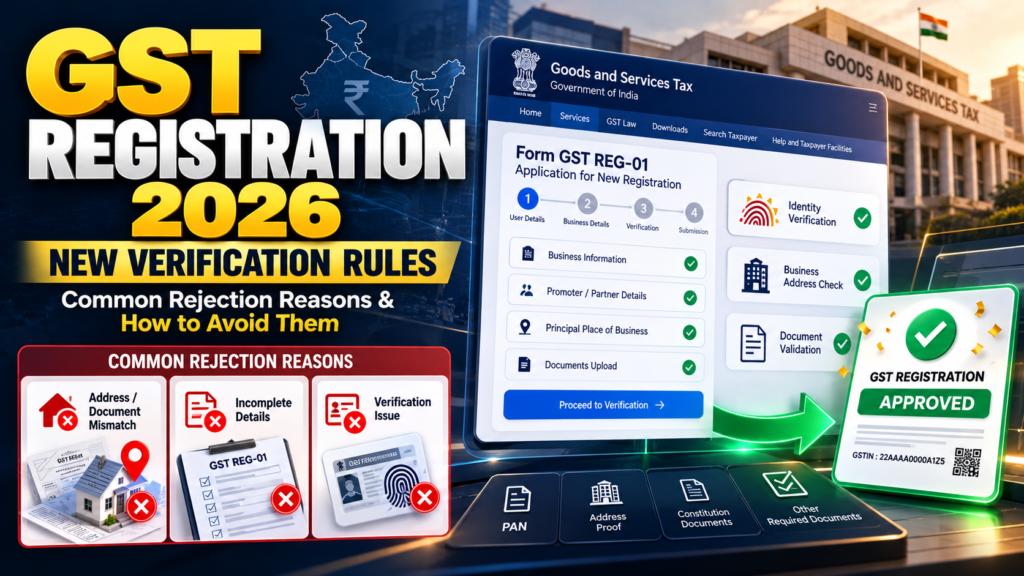
GST Registration in 2026: Why Applications Are Facing Greater Scrutiny GST registration is often treated as a simple online form-filling exercise. For a business owner, the process may appear straightforward: Create application → Upload documents → Complete authentication → Receive GSTIN But a registration application is also a verification exercise. The GST portal validates information submitted by the applicant, and the application can involve Aadhaar authentication, document checks and, depending on the circumstances, verification by the tax officer. Incorrect business details, inconsistent documents, address-related issues, authentication failures or unclear supporting evidence can result in queries, delays or rejection. The GST portal’s current registration guidance confirms that Aadhaar authentication is integrated into the registration process and that the treatment of the application differs depending on whether Aadhaar authentication is successfully completed. Where Aadhaar authentication is successfully completed, the application can be deemed approved within the prescribed 7-working-day framework if no action is taken by the tax officer. Where Aadhaar authentication is not opted for, the application is subject to mandatory site-visit verification and a longer deemed-approval timeline. That makes one thing clear: GST registration in 2026 is not just about submitting the form. It is about making sure the information submitted can be independently verified. What Is GST Registration? GST registration is the process through which an eligible person or business obtains a GST Identification Number (GSTIN) and becomes registered under the applicable GST framework. Once registered, a business may have obligations relating to: GST invoicing Tax collection GSTR-1 GSTR-3B Input Tax Credit E-invoicing, where applicable E-way bills GST payments Annual or other applicable compliance Record maintenance For businesses crossing the applicable registration threshold or otherwise becoming liable under GST provisions, obtaining registration correctly is the first step toward compliant operations. But an incorrect registration can create problems later. What Has Changed in the GST Registration Verification Process? It is important to distinguish between new legal changes and the GST portal’s existing verification framework. Aadhaar authentication, e-KYC and verification mechanisms have been part of GST registration for several years, but the compliance environment continues to become increasingly data-driven. The GST portal currently provides Aadhaar authentication options based on the constitution of the business. For example, the authentication framework identifies the relevant persons for proprietorships, partnerships, companies, LLPs and other entities. The portal also has mechanisms for document upload, verification and application processing. This means that businesses should approach registration as a data-consistency exercise. Your: PAN → Legal name → Business constitution → Authorized signatory → Address → Ownership documents → Bank details → Supporting documents should tell the same story. If these records contradict one another, the application becomes more vulnerable to clarification requests or rejection. 8 Common Reasons GST Registration Applications Get Rejected in 2026 1. Principal Place of Business Cannot Be Properly Verified One of the most common problem areas is the principal place of business. The address entered in the GST application should correspond with the documents submitted as proof. Potential problems include: Incorrect address Incomplete address Wrong PIN code Mismatch between rent agreement and application Address not matching electricity bill Property owner’s name mismatch Missing ownership/occupancy evidence Inadequate consent documentation Business operating from an address without adequate supporting proof For businesses operating from rented premises, the documentation should clearly establish the relationship between the applicant and the premises. For owned premises, appropriate ownership/address evidence should be maintained. The GST portal also uses the PIN code entered in the principal place of business section to determine the relevant State and Centre jurisdiction. Therefore, even a basic address-entry error can create downstream problems. 2. Aadhaar Authentication Failure Aadhaar authentication is an important part of the GST registration process for applicable applicants. The portal provides an Aadhaar Authentication tab during registration and identifies the persons required to undergo authentication based on the constitution of the business. Authentication can fail for various reasons, including issues connected with: Aadhaar details Name mismatch Authentication status Aadhaar locking/biometric-related issues Incorrect details Authentication link issues GSTN has previously enhanced the Aadhaar authentication failure communication to provide information such as the authentication response code and the reason for failure, including certain Aadhaar or biometric-related reasons. How to Avoid It Before starting the application: PAN details + Aadhaar details + authorized signatory details should be checked for consistency. Do not leave Aadhaar authentication until the last moment. 3. PAN and Legal Name Mismatch The GST registration system validates PAN-related information. A mismatch between the legal name associated with PAN and the name entered in the application can create validation issues. The GST portal’s documentation confirms that PAN validation checks whether the PAN details correspond with the legal name and other relevant information. This becomes particularly important when businesses have: Recently incorporated Changed their legal name Converted business constitution Added or removed partners Changed authorised signatories Best Practice Before submitting REG-01, verify: PAN → Legal name → Constitution → Incorporation/partnership documents Do not manually guess the legal name. Use the name exactly as supported by the relevant official records. 4. Incorrect or Incomplete Supporting Documents Uploading documents is not enough. The documents must be: Relevant Legible Complete Consistent with the application Properly signed where required Uploaded in the prescribed format The GST portal specifically warns that blank documents cannot be uploaded and may require re-uploading. It also warns applicants where an uploaded document is unclear or difficult to read. Common documentation problems include: Blurry electricity bill Incomplete rent agreement Missing owner consent Incorrect business address Expired documents Document uploaded under the wrong category Different names across documents Missing pages Unreadable scans A registration application can fail because the underlying information is correct but the evidence is inadequate. 5. Business Constitution Details Do Not Match The GST application asks for information about the constitution of the business. This may include: Proprietorship Partnership LLP Private company Public company HUF Trust Society Other applicable categories The information should correspond with the underlying legal documents. For example, a partnership application should be consistent with the partnership deed and PAN details. A