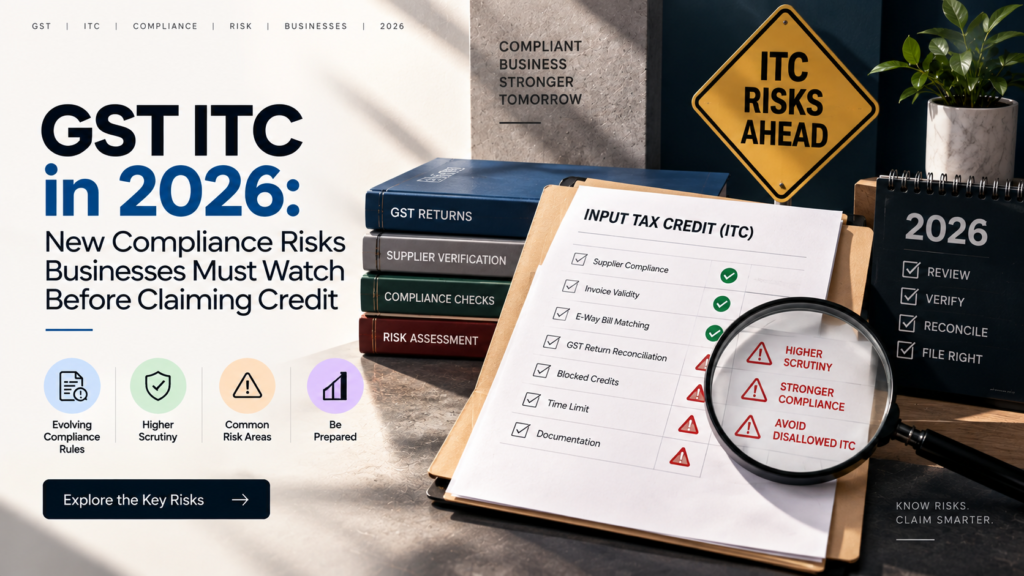
GST ITC in 2026: New Compliance Risks Businesses Must Watch Before Claiming Credit
TL:DR Input Tax Credit remains one of the biggest working-capital advantages under GST. But in 2026, simply having a tax invoice and seeing an amount in GSTR-2B is not enough to treat every rupee as automatically claimable. The GST system increasingly relies on data matching, return analytics and supply-chain verification. Businesses therefore need to look beyond the invoice and ask a more important question: Is this ITC legally eligible, properly supported, correctly reflected and capable of surviving departmental verification? GSTN’s own guidance makes this distinction clear. GSTR-2B is an auto-drafted statement based on information furnished by suppliers and other specified sources, but taxpayers are still required to self-assess ITC eligibility. There can be situations where credit is not available even though it appears in the system-generated information. This becomes even more important because the tax administration is actively using data analytics to detect suspicious ITC claims. In 2026, enforcement actions have included cases involving bogus invoices, non-existent suppliers, cancelled registrations and ITC claimed without actual receipt of goods. For businesses, the message is clear: ITC should be treated as a compliance-controlled asset, not simply as a number available in GSTR-2B. What Is GST Input Tax Credit? Input Tax Credit allows an eligible registered taxpayer to set off GST paid on qualifying business purchases against output GST liability, subject to the conditions and restrictions prescribed under GST law. For example, assume a manufacturer purchases raw materials for: Taxable value: ₹10,00,000 GST paid: ₹1,80,000 If the purchase satisfies the applicable ITC conditions, the eligible ₹1,80,000 may be available for utilisation against output tax liability. But the credit does not become automatically valid merely because the invoice exists. Businesses need to evaluate: Whether the supplier is genuine Whether the supply actually took place Whether the invoice contains correct particulars Whether the transaction is properly reported Whether the credit appears appropriately in GSTR-2B Whether the recipient satisfies the applicable ITC conditions Whether the credit is blocked or restricted Whether the claim is within the statutory time limit Whether sufficient documentary evidence exists Why GST ITC Compliance Risk Is Increasing in 2026 GST compliance is becoming increasingly data-driven. The department can compare information across: GSTR-1 → GSTR-2B → GSTR-3B → E-way bills → E-invoices → Supplier profile → Tax payments → Other available data This means an ITC claim may be viewed not only at the invoice level but also in the context of the broader transaction and supply chain. Recent enforcement demonstrates the seriousness of this approach. In February 2026, CGST authorities reported a case involving fraudulent ITC of approximately ₹6.53 crore based on bogus invoices, with some suppliers found to be non-existent, non-functional or having cancelled/suspended registrations. In another March 2026 case, authorities reported fraudulent ITC of approximately ₹60.59 crore through bogus invoices worth ₹397.23 crore. These cases involve alleged fraud rather than ordinary compliance errors, but they demonstrate why businesses need stronger controls around the authenticity and traceability of their input transactions. 9 GST ITC Compliance Risks Businesses Must Watch in 2026 1. Treating GSTR-2B as Automatic ITC Approval This is one of the most important misconceptions businesses need to eliminate. GSTR-2B tells you what credit is reflected based on supplier-reported information and other system inputs. It does not mean: “Everything appearing in GSTR-2B can automatically be claimed.” GSTN specifically states that taxpayers may have other reasons for ITC being unavailable even where the credit is reflected in GSTR-2B. Taxpayers are advised to self-assess and reverse or refrain from claiming credit where required. Therefore, the correct process is: GSTR-2B → Eligibility check → Books reconciliation → Documentation → ITC claim Not: GSTR-2B → Automatic claim 2. Supplier Default Can Create ITC Risk A business may receive a genuine invoice from a supplier but still face reconciliation problems if the supplier: Does not file the relevant return Reports the invoice incorrectly Uses the wrong GSTIN Reports an incorrect taxable value Uploads the invoice late Cancels or amends the invoice Has GST registration suspended or cancelled Fails to maintain proper records This is why supplier compliance monitoring is becoming an important part of ITC management. A business should not wait until the annual audit to discover that a major supplier has repeatedly caused ITC mismatches. 3. Fake or Non-Genuine Suppliers One of the highest-risk areas is claiming ITC on transactions involving suppliers that are not genuine. The department’s 2026 enforcement actions show that authorities are investigating supply chains where invoices exist but the underlying goods or services were not actually supplied. In one case, backward supply-chain analysis identified a lack of genuine inward supplies at multiple levels. This means businesses should be particularly cautious about: New vendors with unusual pricing Vendors with limited business history Suppliers with inconsistent filing patterns Transactions without transport evidence High-value purchases lacking supporting documents Suppliers whose registrations are cancelled or suspended Circular trading patterns A GST invoice alone is not a substitute for evidence of an actual transaction. 4. ITC Without Actual Receipt of Goods or Services Actual receipt is a critical compliance consideration. Businesses claiming credit should maintain evidence demonstrating that the underlying supply actually occurred. Depending on the transaction, this may include: Purchase order Tax invoice Delivery challan E-way bill Goods receipt note Transport documents Warehouse records Stock register Service completion records Work orders Contracts Payment records Correspondence with the supplier The exact documentation will depend on the nature of the transaction. For goods, inventory and logistics evidence can be particularly important. For services, businesses should maintain evidence showing that the service was actually provided and used for business purposes. 5. GSTR-2B vs Books vs GSTR-3B Mismatch Businesses often focus only on GSTR-2B reconciliation. A stronger process compares at least: Purchase Register ↔ Books of Accounts ↔ GSTR-2B ↔ GSTR-3B A mismatch can arise because: Supplier has not uploaded the invoice Supplier uploaded it with incorrect GSTIN Invoice was amended Credit note was issued Duplicate invoice was recorded Purchase was booked in a different period ITC was claimed in the wrong month ITC was reversed but