
LNG prices surge by 50% in Europe after Qatar shuts world’s largest gas plant| Business News
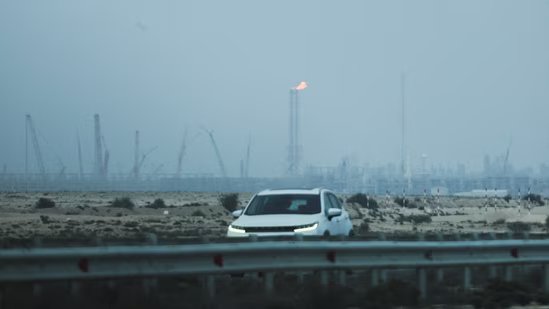
LNG prices in Europe surged more than 50% after Qatar shut down production at the world’s largest export facility after it was targeted in an Iranian drone attack. The unprecedented halt marks a dramatic escalation of the Iran war that now threatens energy security worldwide. A car passes near QatarEnergy’s LNG production facilities, amid the Iran war, in Ras Laffan Industrial City of Qatar on Monday, 2 March 2026. (Reuters) European benchmark gas futures jumped the most in nearly four years, after QatarEnergy confirmed on Monday that output had been suspended. Tankers had already largely stopped transiting the Strait of Hormuz—a critical artery for global fuel shipments. QatarEnergy’s Ras Laffan plant supplies about a fifth of global LNG supply. The situation risks the most serious shock to gas markets since Russia’s invasion of Ukraine four years ago upended global energy trade. While Asian countries buy most of the LNG shipped from the Middle East, any disruption would increase competition for alternative supplies—pushing up prices worldwide, including in Europe. The shutdown of the plant “marks an abrupt acceleration in the energy implications of the situation,” said Simone Tagliapietra, an analyst at Bruegel. “The threat to security of supply is here and now. The extent of it will depend on the duration of the shutdown, but we are now into a new scenario.” Shipping risks are compounding the disruption. The Strait of Hormuz is a key shipping route for energy, carrying about a fifth of the world’s liquefied natural gas exports. The dramatic slowdown of traffic through the waterway has created major bottlenecks potentially causing fuller storage tanks for QatarEnergy. More than half of the world’s largest maritime insurance clubs will stop providing war-risk cover for vessels entering the Persian Gulf starting Thursday, Bloomberg reported, a move likely to deter cargo loadings in the region. On top of that, Israel on Saturday ordered the temporary closure of some gas-producing capacities, including its biggest Leviathan gas field. That prompted major importer Egypt to seek more LNG cargoes. Gas trade disruptions in the Middle East could also eventually raise spot LNG demand from Turkey, according to BloombergNEF, as it imports pipeline fuel from Iran. “The price shock from the loss of Middle East LNG could be similar to 2022, after Russia’s invasion of Ukraine,” said Mike Fulwood, senior research fellow at the Oxford Institute for Energy Studies. Such a surge “could have dire consequences for government budgets in Europe and Asia.” The conflict continues to deepen, with blasts heard across Israel, Saudi Arabia, Qatar and the United Arab Emirates, as states intercepted Iranian missiles launched in response to US-Israeli strikes. US President Donald Trump said the bombing campaign against Iran could last for weeks.
Saudi Aramco shuts down Ras Tanura refinery after drone strike| Business News
Saudi Aramco has shut down its Ras Tanura refinery as a precautionary measure after the facility was hit by a drone, in an escalation of the Iran war that now threatens to ensnare the whole of the Middle East. Crude oil prices surged to $80/barrel on the news. The logo of Saudi Aramco. (REUTERS) Two drones were intercepted at the facility, with the debris causing a limited fire, a spokesperson for the Saudi Defence Ministry said on Al Arabiya TV, adding there were no injuries. The shuttering of Saudi Aramco’s Ras Tanura refinery—among the largest in Saudi Arabia—will likely add to supply worries as the Strait of Hormuz grinds to a near-halt. At least three tankers were attacked in the waterway that carries nearly a fifth of world’s crude oil supply daily. “The attack on Saudi Arabia’s Ras Tanura refinery marks a significant escalation, with Gulf energy infrastructure now squarely in Iran’s sights,” Torbjorn Soltvedt, principal Middle East analyst at risk intelligence firm Verisk Maplecroft, told Reuters. “The attack is also likely to move Saudi Arabia and neighbouring Gulf states closer to joining US and Israeli military operations against Iran.” The Ras Tanura complex, on the kingdom’s Gulf coast, houses one of the Middle East’s largest refineries with a capacity of 550,000 barrels per day (bpd) and serves as a critical export terminal for Saudi crude. Aramco did not immediately respond to an emailed request for comment. The drone strike added to a wave of attacks on the region, including on Abu Dhabi, Dubai, Doha, Manama and Oman’s commercial port of Duqm. Most of oil production in the Kurdistan region of Iraq, which exported around 200,000 bpd in February to Turkey, was shut down over the weekend as a precaution. Saudi Arabia’s heavily fortified energy facilities have been targeted previously, most notably in September 2019 when unprecedented drone and missile attacks on the Abqaiq and Khurais plants temporarily knocked out more than half of the kingdom’s crude production and roiled global markets. Ras Tanura was attacked by Yemen’s Iran-aligned Houthis in 2021, in what Riyadh called a failed assault on global energy security. Crude Oil Prices West Texas Intermediate, the light, sweet crude oil produced in the United States, was selling for $72.79 a barrel early Monday, up 8.6% from its trading price of about $67 on Friday, according to data from CME group. A barrel of Brent crude—the international standard—was trading at $79.41 per barrel early Monday, according to FactSet, up 9% from its trading price of $72.87 on Friday, at the time a seven-month high. Higher global energy prices mean consumers will pay more for gasoline at the pump and have to shell out more for groceries and other goods at a time when many are already feeling the impacts of elevated inflation.