US Supreme Court rejects Trump tariffs in potential reset of US foreign policy| Business News
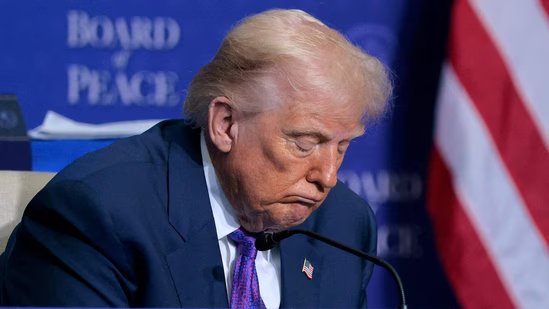
The US Supreme Court struck down President Donald Trump’s sweeping tariffs that he pursued under a law meant for use in national emergencies, rejecting one of his most contentious assertions of his authority in a ruling with major implications for the global economy. US President Donald Trump. Trump tariffs have been central to a global trade war that he initiated in his second term as president. (Getty Images via AFP) The justices, in a 6-3 ruling authored by conservative Chief Justice John Roberts, upheld a lower court’s decision that the Republican president’s use of this 1977 law exceeded his authority. Roberts, citing a prior Supreme Court ruling, wrote that “the president must ‘point to clear congressional authorisation’ to justify his extraordinary assertion of the power to impose tariffs”, adding: “He cannot.” Trump has leveraged tariffs—taxes on imported goods—as a key economic and foreign policy tool. They have been central to a global trade war that Trump initiated after he began his second term as president, one that has alienated trading partners, affected financial markets and caused global economic uncertainty. The Supreme Court reached its conclusion in a legal challenge by businesses affected by the tariffs and 12 US states, most of them governed by Democrats, against Trump’s unprecedented use of this law to unilaterally impose the import taxes. Trump’s tariffs were forecast to generate over the next decade trillions of dollars in revenue for the United States, which possesses the world’s largest economy. Trump’s administration has not provided tariff collection data since 14 December. But Penn-Wharton Budget Model economists estimates the amount collected in Trump’s tariffs based on the International Emergency Economic Powers Act stood at more than $175 billion. And that amount likely would need to be refunded with a Supreme Court ruling against the IEEPA-based tariffs. The US Constitution grants Congress, not the president, the authority to issue taxes and tariffs. But Trump instead turned to a statutory authority by invoking IEEPA to impose the tariffs on nearly every US trading partner without the approval of Congress. Trump has imposed some additional tariffs under other laws that are not at issue in this case. Based on government data from October to mid-December, those represent about third of the revenue from Trump-imposed tariffs. IEEPA lets a president regulate commerce in a national emergency. Donald Trump became the first president to use IEEPA to impose tariffs, one of the many ways he has aggressively pushed the boundaries of executive authority since he returned to office in areas as varied as his crackdown on immigration, the firing of federal agency officials, domestic military deployments and military operations overseas. Trump described the tariffs as vital for US economic security, predicting that the country would be defenseless and ruined without them. Trump in November told reporters that without his tariffs “the rest of the world would laugh at us because they’ve used tariffs against us for years and took advantage of us”. Trump said the United States was abused by other countries including China, the second-largest economy. After the Supreme Court heard arguments in the case in November, Trump said he would consider alternatives if it ruled against him on tariffs, telling reporters that “we’ll have to develop a ‘game two’ plan.” Treasury Secretary Scott Bessent and other administration officials said the United States would invoke other legal justifications to retain as many of Trump’s tariffs as possible. Among others, these include a statutory provision that permits tariffs on imported goods that threaten US national security and another that allows retaliatory actions including tariffs against trading partners that the Office of the US Trade Representative determines have used unfair trade practices against American exporters. None of these alternatives offered the flexibility and blunt-force dynamics that IEEPA provided Trump, and may not be able to replicate the full scope of his tariffs in a timely fashion. Trump’s ability to impose tariffs instantaneously on any trading partner’s goods under the aegis of some form of declared national emergency raised his leverage over other countries. It brought world leaders scrambling to Washington D.C. to secure trade deals that often included pledges of billions of dollars in investments or other offers of enhanced market access for US companies. But Trump’s use of tariffs as a cudgel in US foreign policy has succeeded in antagonising numerous countries, including those long considered among the closest US allies. IEEPA historically had been used for imposing sanctions on enemies or freezing their assets, not to impose tariffs. The law does not specifically mention the word tariffs. Trump’s Justice Department had argued that IEEPA allows tariffs by authorizing the president to “regulate” imports to address emergencies. The Congressional Budget Office has estimated that if all current tariffs stay in place, including the IEEPA-based duties, they would generate about $300 billion annually over the next decade. Total US net customs duty receipts reached a record $195 billion in fiscal 2025, which ended on 30 September, according to US Treasury Department data. On April 2 on a date Trump labeled “Liberation Day”, the president announced what he called “reciprocal” tariffs on goods imported from most US trading partners, invoking IEEPA to address what he called a national emergency related to US trade deficits, though the United States already had run trade deficits for decades. In February and March of 2025, Trump invoked IEEPA to impose tariffs on China, Canada and Mexico, citing the trafficking of the often-abused painkiller fentanyl and illicit drugs into the United States as a national emergency. Trump has wielded his tariffs to extract concessions and renegotiate trade deals, and as a weapon to punish countries that draw his ire on non-trade political matters. These have ranged from Brazil’s prosecution of former president Jair Bolsonaro, India’s purchases of Russian oil that help fund Russia’s war in Ukraine, and an anti-tariffs ad by Canada’s Ontario province. IEEPA was passed by Congress and signed by Democratic President Jimmy Carter. In passing the measure, Congress placed additional limits on the president’s authority compared
Tata Motors enters BaaS space with Punch.ev in quest for ICE-EV price parity| Business News
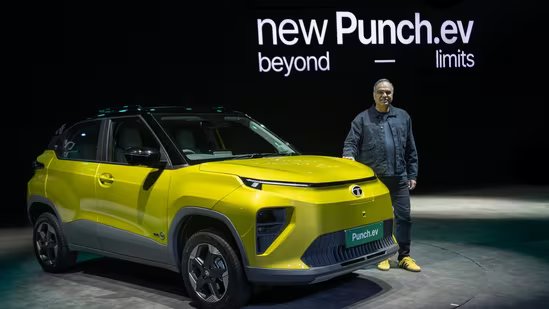
Tata Motors PV Ltd. has launched the updated Punch.ev, offering battery-as-a-service for the first time, as India’s largest EV maker eyes price parity with ICE equivalents. Tata Motors PV Managing Director Shailesh Chandra with the updated Punch.ev at a launch event in Mumbai on Friday, 20 February 2026. (Handout) The sub-compact electric SUV is now available at an ex-showroom price of ₹9.69 lakh. The price goes down to ₹6.49 lakh under the BaaS financing model. The battery EMI is fixed at ₹2.6/km. “The new Punch.ev, makes electric mobility truly accessible, practical and worry free for every household,” Shailesh Chandra, managing director of Tata Motors PV and Tata Passenger Electric Mobility Ltd., said in a statement. According to him, the Punch.ev resolves the core concerns that have held consumers back from choosing an entry-level EV as their primary car. Punch.ev: Battery Packs and Range The Punch.ev is available in three distinct personas: Smart, Adventure, and Empowered. Buyers can select between two battery configurations: a standard 30 kWh option and a larger 40 kWh lithium-iron phosphate prismatic cell pack. The 40 kWh variant delivers an ARAI-certified range of 468 km and an estimated real-world range of approximately 355 km, positioning it for both urban commute and short intercity trips. Pricing tops out at ₹12.59 lakh for the Empowered +S trim equipped with the 40 kWh battery. The Punch.ev supports fast-charging to replenish the battery from 20% to 80% in 26 minutes. A 15-minute top-up can add up to 135 km of real-world range. The 40 kWh variant is backed by a lifetime high-voltage battery warranty covering unlimited kilometres for the first owner over a fifteen-year period. Punch.ev: The BaaS offering Tata Motors PV’s BaaS dual-loan finance option separates the vehicle’s base cost from battery utilisation. The advertised BaaS pricing is applicable to the Smart 30 kWh trim and assumes a daily usage of 60 km, excluding charging costs. The plan also includes assured buyback options, ranging from 40% buyback after five years to 60% after three years. With the Punch.ev, Tata Motors joins the likes of JSW MG Motor India Pvt. Ltd. and Maruti Suzuki India Ltd. in offering BaaS with its electric cars. The Maruti Suzuki eVitara is available at a starting price of ₹10.99 lakh, with BaaS EMI set at ₹3.99/km. The MG cars — Comet EV, Windsor EV and ZS EV — have a BaaS EMI ranging from ₹2.5/km to ₹4.5/km. Charging Infra, Service Network The launch of the Punch.ev coincides with Tata Motors PV’s broader push to solidify its charging ecosystem. The company’s network currently includes 2.3 lakh charging points across 1,500 Indian cities, aggregating more than 30,000 public chargers from over 30 operators. TATA.ev is also expanding its proprietary superfast charging network, aiming to grow its footprint of more than 450 points on 80 highways to 800 charging points by the end of FY26.
Owen Larter of Google DeepMind| Business News

At a time when artificial intelligence (AI) is no longer a laboratory breakthrough but a geopolitical and developmental force, Google DeepMind is recalibrating how it works with governments. This week, they announced its National Partnerships for AI with the Indian government, which includes working with the Anusandhan National Research Foundation (ANRF) to make its scientific AI models more accessible, as well as supporting IIT-Bombay with a grant of $50,000 to use Gemma to process Indic language health governance and policy documents to build a novel ‘India-Centric Trait Database’. Owen Larter, senior director and head of frontier policy and public affairs at Google DeepMind. (Official image) For Owen Larter, who is senior director and head of frontier policy and public affairs at Google DeepMind, this is not merely an expansion in a large market, but reflects a view that India’s position is uniquely catalytic, with strong ties to the developing world. It must play a role in shaping how AI benefits are distributed more equitably across geographies. Yet, Larter argues the responsibility to ensure AI works safely for everyone also lies with companies building frontier systems, who must actively ensure governments understand what these technologies can do. Transparency, he suggests, is a prerequisite for effective regulation. Edited excerpts: Q. Google DeepMind has been vocal about extreme risks from advanced AI. How do you prioritise near-term harms versus longer-term existential concerns in your policy work? Owen Larter: This is a really important conversation, and obviously our mission is to develop advanced AI and put it into the world responsibly. We’re excited about how people are using this technology, such as leading Indian scientists using AlphaFold to develop new types of cancer therapies. If we’re going to continue to build progress in this, we need to make sure this technology is trustworthy and we need to continue to build out governance frameworks. There is a little bit of a danger in segmenting different risks that we need to address. This is going to be a sort of continuous journey, to come up with durable frameworks. There are a few principles that we must work to. We need to continue to build a really solid scientific understanding of the technology, of what it can do, its capabilities, and its limitations. It’s critical to then work with partners to understand the impact this technology will have when it’s used in the real world, and of testing for mitigation. That’s really an approach that we need to apply across whatever the set of risks is, whether it’s protecting child safety or making sure that our systems are useful in different languages, through to critical risks of advanced frontier systems developing capabilities that could be misused by bad actors to perpetrate a cyberattack or create a biological weapon. DeepMind has the frontier safety framework since 2024, which we iterate over time. This will not be a static issue. AI governance is never going to be a solved problem, it is an ongoing journey. Q. We are witnessing differing regulatory philosophies emerging globally? Is convergence desirable, or should we expect regulatory pluralism? Owen Larter: I think there’s certainly convergence in certain places. All of these different regulatory philosophies are trying to do the same thing; every country wants to use AI across their economies. But there are risks that need to be understood and addressed. We are seeing some different approaches, where the EU has moved first and a little bit further than other jurisdictions. The US is taking a slightly different approach, and there are some state regulations addressing frontier governance in California and New York now. That will continue to develop. We want to lean in and be helpful to governments worldwide, to help them understand the technology. It’s a responsibility on our part to share information around what it can do today and where it’s going. One bit of the conversation that has been really heartening this week is the attention to the importance of developing standardised best practises for testing of systems for risks, and applying mitigation before a system goes into the world. Q. The AI Safety Summit series represents international coordination. What mechanisms are proving most effective in translating high-level commitments into policy action? Owen Larter: The India AI Impact Summit in particular has been really important in shining light on some important issues that haven’t been addressed as much in previous summits, particularly the importance of spreading access and opportunity with AI and making sure that you’re putting it into the hands of people. The multilingual discussions that have happened are essential. It’s something that we’re leaning into and trying to do more of, with our grant for IIT-Bombay. Regular discussion at a global level, is really important. I’m really pleased this will be carried forward in Switzerland and then the UAE. Q. Given India’s strengths in digital public infrastructure and its scale of deployment, what unique contributions could it make to global AI governance discussions? Owen Larter: It’s been absolutely fundamental that as the technology matures, discussions around how to use it are maturing alongside. It’s great that this summit series is broadened out slightly. I think India is going to be absolutely foundational to how this technology is developed and used. It is clear that India is going to be an AI powerhouse within its own rights. That’s why we are continuing to continuing to invest here. Q. At what point does a model become ‘frontier’ for governance clarity? Owen Larter: We need to think about different types of systems, to advance understanding around how they work, and the risks. From a legal perspective, defining is important but is easy to caught up in the semantics. We think of frontier systems as being sort of the most advanced systems that exist at any one point. Of course, the frontier continues to advance, with systems becoming more capable. One of the reasons we’re interested in frontiers is, they may develop capabilities that could pose risks. Our framework is a
Exclusive | India must lead agentic payment regulation: Razorpay’s Rahul Kothari

Imagine asking an artificial intelligence (AI) assistant what looks an otherwise simple enough question, “what to order for dinner”, and seamlessly proceed to the “order is on the way” stage, within the same conversation. That’s the world of agentic AI payments that Razorpay, India’s largest payment aggregator, envisions. The fintech, at the India AI Impact Summit 2026, has announced agentic payments on Anthropic’s Claude. It is, as Rahul Kothari, who is chief operating officer at Razorpay tells HT, “commerce being re-architected”. Rahul Kothari, chief operating officer at Razorpay. (Official image) This is the coming together of Razorpay’s Agentic Payments feature, India’s UPI infrastructure led by the National Payments Corporation of India (NPCI), and Claude’s conversational intelligence, in a medley hoping to turn everyday AI conversations into real, completed purchases. Alongside, Razorpay is also partnering with global agentic software creation platform Replit to help AI developers integrate monetisation options in apps they build. The Anthropic AI-led payments chapter comes a few months after Razorpay rolled out agentic payments on OpenAI’s ChatGPT, as well as connectors for Google Gemini. Kothari believes that in the new age of AI commerce, trust design is going to matter more. “We are moving towards a world where checkouts will become invisible, and therefore trust on payments will be important,” he says. Crucial to agentic payments aspirations is UPI Reserve Pay, a feature that allows users to reserve a set amount of money from their RuPay credit card, a bank account on UPI or a pre-sanctioned credit line, and make payments from that pool. Razorpay and Anthropic’s agentic commerce chapter presently has Zomato, Swiggy and Zepto as partner platforms. “UPI really is the secret weapon for agentic commerce too. It lets you block funds for an agent without having to share payment credentials. No other real-time payments or card system does this natively,” says Kothari. Razorpay is dominant in India’s online payment gateway space, with over 55% share. The AI chatbot, when asked more generic questions such as “order dinner for two under ₹800 from my favourite restaurant”, will be able to search options on Zomato and Swiggy, and complete payment post a user’s confirmation. Kothari insists the core thought behind integrating agentic payments to work with popular quick commerce and food delivery apps, is to redefine how intent becomes an economic action, in an envelope of familiarity. Regulatory conversation is inevitable The current payments systems are designed on one foundational assumption, that a human decided to make this payment. The liability frameworks, dispute mechanisms and fraud prevention all are based on this assumption. Agentic payments break this, entirely. Kothari points out that in previous months, their learnings about agentic payments trends points to a heartening trend — users don’t really fear making AI payments. But he draws a line in the sand. “They do fear losing control, and the challenge for us is to solve real time tracking, instant revocation and user-defined spend limits,” he says. When an AI books a flight for you and the airline charges twice, who is liable — you, the AI platform, the payment processor, or the airline? When there’s no checkout page, consent is legally undefined. When an AI misinterprets a user’s instructions and buys the wrong thing, is that a fraud dispute, a product dispute, or something the existing rule books simply don’t answer, for now? The question regulators will have to define with an answer at some stage is, when AI makes a transaction error, who is liable? “India is best positioned to lead here because the Reserve Bank of India and NPCI have always been innovation friendly. There must be guardrails. UPI was a regulatory innovation, and the same method is applied in the AI commerce as well,” Kothari says, before pointing out the complexity that “AI will keep evolving and you can’t really write rules for every AI agent”. “Regulators in India will take the lead in how governance is supposed to happen,” he hopes, suggesting mechanisms such as user based consent for payments above a certain value per transaction, ability to revoke a permission to pay, and liability change must be step based. India’s digital payments trajectory doesn’t need much in terms of an illustration for the uninitiated. NPCI official data indicates UPI transactions clocked ₹28.33 lakh crore in value and 21.7 billion in volume in January — highest monthly statistics for UPI. Alongside, India’s credit card spends at ₹2.12 lakh crore for 552 million transactions, just shy of the ₹2.17 lakh crore record set in September. For agentic payments to succeed, in terms of adoption, Kothari believes the payment infrastructure must be platform agnostic. “The AI layer, whether it is ChatGPT or Gemini or Claude, is just the interface. The payment system has to work the same way regardless of which AI is on top,” he says. The term he uses is “non-negotiable”. Razorpay has maintained significant momentum in previous months, including receiving the Offline Payment Aggregator (PA-P) licence from RBI, for collecting in-store payments, last month.