Demis Hassabis sees AGI on the horizon in 5-8 years, as ‘we aren’t there yet’| Business News
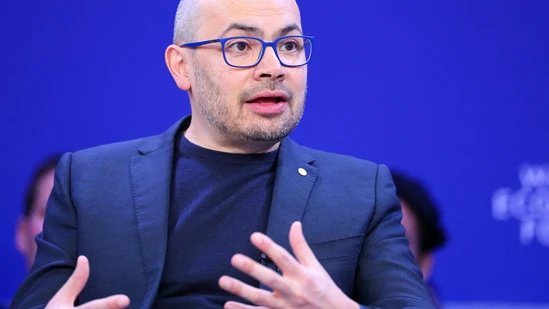
Technology isn’t there yet in terms of Artificial General Intelligence, or AGI, but it’s certainly on the horizon, Google DeepMind CEO Demis Hassabis said at the India AI Summit in New Delhi on Wednesday. DeepMind CEO Demis Hassabis. (Reuters) “We are going to enter a golden era for scientific discovery, almost a new era,” Hassabis, who won the 2024 Nobel Prize in Chemistry for his groundbreaking work on protein structure prediction using AI, said during a conversation with IIT Madras Professor B. Ravindran. As for AGI, “we are not there yet”. “There are still things that systems can’t do—things like continued learning still needs to happen,” Hassabis said. One of the biggest issues is consistency, long-term planning. “Systems today can get international Math Olympiad medals, but can still make mistakes in elementary math. (AI) is still jagged that way,” the DeepMind CEO said. “It’s been amazing to see the progress we have made in just over a decade. The threshold moment where AGI is on the horizon is 5-8 years,” he said.
India is a blueprint for democratising AI globally, Sundar Pichai says| Business News
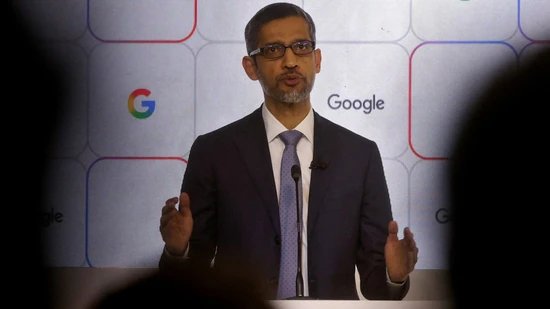
India is a blueprint for democratising AI globally, Alphabet Inc. CEO Sundar Pichai said on Wednesday, unveiling a plethora of Google AI initiatives to tap into the world’s largest internet population outside of China. Google and Alphabet CEO Sundar Pichai speaks at a press conference in New Delhi on Wednesday, 18 February 2026. (Reuters) India is poised for an “extraordinary trajectory” in AI as the language ecosystem and digital infrastructure here make for a “powerful foundation for innovation”, Pichai said during a press conference in New Delhi on Wednesday, ahead of his session at the India AI Impact Summit 2026 later this week. To tap into that unrealised potential, Google made the following announcements for its AI ecosystem in India: The India-America Connect Initiative to deploy new subsea cables between the US, India, and the wider Global South. A partnership with Karma Yogi Bharat to support 2 crore public servants. Atal Tinkering Labs to introduce Google Gen AI tools to 10,000 schools. A $30-million AI for Science Impact Challenge to advance global research. A Google AI Professional Certificate Program in English and Hindi for students and early-career professionals. Google’s $15-billion AI hub in Visakhapatnam including a 1 GW AI data centre and new subsea cables. “AI has the biggest impact when developed and deployed with institutions that understand communities best,” Pichai said. “Google has full-stack connectivity in India, and I have never been more excited about the future we are building together.” Pichai, a graduate of IIT Kharagpur, believes that “AI is the biggest platform shift of our lifetime”. “It must work across languages and local contexts. It must deliver real-world benefits people can rely on. Trust grows when technology is transparent, responsible, and grounded in outcomes,” he said.
Sarvam rivals ChatGPT, Claude with AI models customised for India| Business News
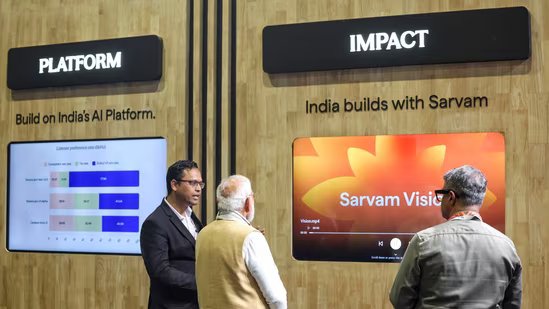
Sarvam AI has unveiled an artificial-intelligence model that’s more tailored for India than the likes of ChatGPT and Claude. Sarvam AI co-founder Pratyush Kumar and Prime Minister Narendra Modi at the company’s pavilion at the India AI Summit in New Delhi on Monday, 16 February 2026. (PMO) The Bengaluru-based AI startup announced two models at the India AI Impact Summit 2026 in New Delhi—a showcase for Prime Minister Narendra Modi’s efforts to make his country a leading player in the emerging technology. Sarvam’s models are built to be used through voice commands and are accessible through 22 Indian languages, which the company says will be a competitive advantage in the country of 1.45 billion where the vast majority can’t read, write or type in English. “Today we show we can bring our own AI to a billion Indians,” said Sarvam co-founder Pratyush Kumar during an event in Delhi. Sarvam also offers what’s known as Agentic AI models that can carry out tasks like coding or meeting planning in large part autonomously and with minimal human intervention. The company says its agents could drive enterprise automation in one of the world’s fastest growing economies. The startup’s unveiling of India-specific models trained from scratch comes as the AI race between the US and China is intensifying. The government is funding AI accelerators and pushing model makers to launch services so the country, one of the largest reservoirs globally of technical talent, isn’t left behind. Sarvam has steep challenges in fending off global competitors. The startup has received more than $50 million in funding, including from Lightspeed Ventures LLC and Khosla Ventures, and was last valued at about $200 million. That’s tiny compared with Silicon Valley leaders like OpenAI and Anthropic PBC, last valued at $500 billion and $380 billion, respectively. It’s also small next to companies like Mistral AI, a French pioneer in the technology that is valued at $13.25 billion and is expanding in India with local languages. Sarvam touts its India-first approach and the security it offers by running its AI models from inside the country. The startup’s models are trained on trillions of Indian data sets, particularly those in Indian languages, making it suitable for real-time deployment at scale in the world’s most populous country not just in local languages but also mixed languages such as Hinglish. In recent benchmark tests, the startup said its models performed with superior accuracy on tasks like optical character recognition for Indian scripts. The Sarvam vision model achieved an accuracy of over 84% on document intelligence tasks, eclipsing global models hundreds of times larger in size. “Sovereignty matters much more in AI than building the biggest models,” said Sarvam’s other co-founder, Vivek Raghavan, at the same event. India is hosting dozens of leading global chief executives, AI founders, country leaders, researchers and policy experts this week as it attempts to position itself as an alternative to the US and China, by leading in “democratising AI” and taking a cost-efficient, language-diverse route. India’s digital infrastructure has relied on foreign technologies for decades so the launch of the Sarvam models is seen as a step toward developing a “sovereign AI” ecosystem within the country. Indian AI startups like Sarvam and BharatGen, which also released a series of India-made models this week, are looking to export their AI systems to other developing economies in the world where neither Chinese nor US models are favoured.
Sundar Pichai calls on PM Modi amid India AI Summit underway in Delhi| Business News
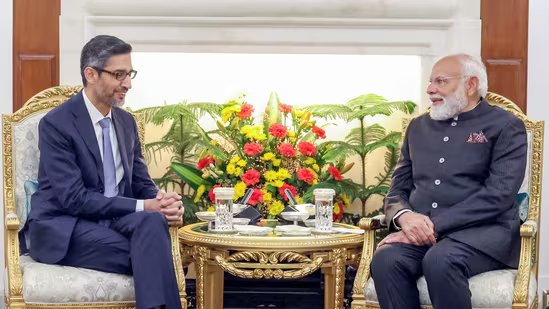
Google CEO Sundar Pichai on Wednesday met Prime Minister Narendra Modi here in the national capital. Pichai is here for the Global AI Impact Summit 2026 and will deliver the keynote address on February 20 at the summit. New Delhi, Feb 18 (ANI): Google CEO Sundar Pichai meets Prime Minister Narendra Modi, in New Delhi on Wednesday. (DPR PMO/ANI Photo) (DPR PMO) Earlier upon arrival, in a post on X, CEO Pichai said, “Nice to be back in India for the AI Impact Summit – a very warm welcome as always and the papers looked great too.” The India AI Impact Summit 2026 is being held at Bharat Mandapam, New Delhi, it started on February 16 and will run up to February 20, 2026.T he Summit brought together government policymakers, industry AI experts, academicians, technology innovators and civil society from across the world at New Delhi to advance global discussions on artificial intelligence. The India AI Impact Summit, the first global AI summit to be hosted in the Global South, aims to reflect on the transformative potential of, AI aligning with the national vision of “Sarvajana Hitaya, Sarvajana Sukhaya” (welfare for all, happiness for all) and global principle of AI for Humanity.
Microsoft warns about growing global AI divide as it pledges $50 billion for Global South| Business News
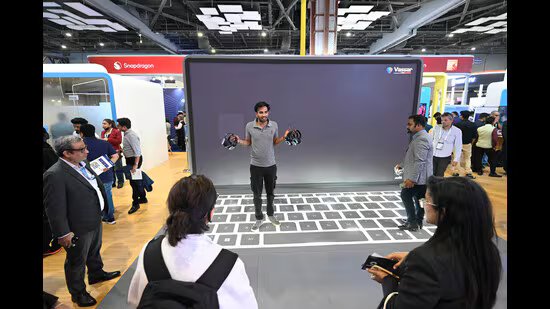
Microsoft is referencing the India AI Impact Summit within the broader context of the Global South while mentioning a $50 billion investment by the end of the decade. To support this point, the tech giant cites its latest AI Diffusion Report, which indicates that the Global North uses artificial intelligence (AI) twice as much as countries in the southern hemisphere. The planned investments hinge on a five-part programme, including building AI infrastructure, providing technology and skills for schools and nonprofits, developing multilingual and multicultural AI capabilities, and fostering local AI innovations that address community needs. Visitors at the Microsoft pavilion at the AI Impact Summit 2026 at Bharat Mandapam in New Delhi on Tuesday. (Sanjeev Verma/HT Photo) “The India AI Impact Summit rightly placed this challenge at the centre of its agenda. For more than a century, unequal access to electricity exacerbated a growing economic gap between the Global North and South. Unless we act with urgency, a growing AI divide will perpetuate this disparity in the century ahead,” says Brad Smith, vice chair and president of Microsoft. This alarm about usage gaps underlines Microsoft’s messaging at the summit. Microsoft explicitly compares AI’s diffusion to electrification, one of the defining infrastructure expansions of the 20th century. Just as unequal access to electricity entrenched economic gaps between the North and South, Microsoft warns that unequal access to AI could cement a new form of structural inequality for decades to come. Comparisons between electricity and AI may be rhetorically effective messaging, but one is a utility while the other is not. The analogy also obscures key realities — AI access is not just a factor of infrastructure, but also of compute concentration. Secondly, most of today’s AI footprint is concentrated among a few companies across the largest models, AI chips, and cloud platforms. Critical infrastructure for the masses is unlikely to be proprietary. “We’re investing in AI infrastructure with sensitivity to digital sovereignty needs. We recognise that in a fragmented world, we must offer customers attractive choices for the use of our offerings. This includes sovereign controls in the public cloud, private sovereign offerings, and close collaboration with national partners,” says Natasha Crampton, Vice President and Chief Responsible AI Officer of Microsoft. Infrastructure access has historically been one of the most durable predictors of long-run economic development, and the barriers to AI adoption include reliable power, connectivity, compute, skilled workers, and software in local languages. The five-part program that Microsoft refers to includes $8 billion in annual investments in cloud and AI data centres, including in India; Microsoft Elevate for Educators training for 2 million teachers in India; investments in language data and model capabilities, including LINGUA Africa; and co-designing AI Trek for agriculture support in East Africa and South Asia. “As India’s guiding sutras for the AI Impact Summit recognise, AI must be applied to address pressing challenges in collaboration with people and organisations in the Global South. Microsoft’s increasing investments prioritise locally defined problems, locally grounded expertise, and real-world impact,” Smith notes. Microsoft’s commitment to invest $50 billion through to the end of the decade may sound transformative for the position of the Global South relative to the Global North, but these investments will primarily flow into data centres, proprietary AI tools, and enterprise partnerships — and the likelihood of platform lock-in on a regional scale remains a possibility. There will have to be greater investments in open model ecosystems, local model training capabilities, and sovereign AI. The skills and education pillar, anchored by the Microsoft Elevate program, targets 20 million AI credential earners by 2028, with a goal of equipping 20 million people in India with AI skills by 2030. Microsoft insists that accelerating the availability of AI, or diffusion, will require a clear understanding of where AI is being used and how, as well as the gaps that persist. “At 24 million, the Indian developer community is the second largest national community on GitHub, where developers learn about and collaborate with the world on AI. The Indian community is also the fastest growing among the top 30 largest economies, with growth at more than 26 percent each year since 2020 and a recent surge of over 36 percent in annual growth as of Q4 2025,” the company says. Microsoft’s contribution to the forthcoming World Bank Global AI Adoption Index, built partly on privacy-preserving signals from GitHub and Azure Foundry, creates a shared empirical baseline that could guide more targeted interventions across the sector. While the company commits to tracking AI diffusion, metrics for success on the $50 billion investment remain vague for now. Data centre investments are measurable, but any impact on actual human development outcomes is far harder to attribute. Secondly, while there seems to be a commitment to digital sovereignty, the prospect that national AI infrastructures will be built on a single hyperscaler’s cloud could create structural dependencies over time. This is also where questions about interoperability, reversibility, data localisation, and long-term pricing come into play.
The financialisation of AI is just beginning| Business News
This year just five American tech giants are set to make $700bn-worth of capital expenditure, as investment in the data centres needed for artificial intelligence surges. Investors have long quipped that “data is the new oil”; now they are backing firms to spend far more to process it. By comparison, the oil and gas industry invested just $570bn in exploration and production last year. Representational Image (Pixabay) Yet in another sense, data—or at least the chips on which it is stored and manipulated—still lags far behind oil. Graphics processing units (GPUs) play a tiny role in financial markets. True, some loans use them as collateral, but they remain hard to price and to sell on. There is practically no market for GPU derivatives, which allow traders to parcel up and offload risks (such as that of a price crash). Chips and the processing power they generate (or “compute”) are therefore ripe to be financialised by Wall Street—just like oil, housing and myriad other assets before them. A wave of new innovators hopes to do just that. Take OneChronos, a fintech firm established in 2016 to make share-trading more efficient. The company aims to launch a market for compute, on which bundles of goods can be auctioned, by June. It has paired up with Auctionomics, founded by Paul Milgrom, who won the Nobel prize for economics in 2020. Then there is Ornn, which has launched an index tracking the prices of chips, including Nvidia’s popular H100. The startup also plans to sell put options—derivative contracts that pay out if prices fall sharply—on physical GPUs. Eventually, the combination of trusted benchmarks and liquid derivatives markets could support bonds collateralised by baskets of GPUs, much like those backed by bundles of individual loans. Few investors possess detailed knowledge of Californian consumers or Ohio’s office market. Many nevertheless snap up bonds collateralised by credit-card debt and commercial mortgages. To build such a market, some fearsome obstacles must be overcome. Perhaps the biggest one is that the most advanced chips tend to lose their value fast, as even whizzier ones come to market. Morgan Stanley estimates that this could prompt Alphabet, Microsoft, Meta and Oracle to record depreciations worth $680bn over the next four years. Any estimate like this is subject to huge uncertainty, since no one can know for sure how the technology will progress. This represents a big risk to buyers of loans collateralised by GPUs that might unexpectedly tumble in price. Even now, for the biggest buyers of chips, comparing the most recent models to those of a decade ago is like comparing a supersonic jet to a horse and cart. Then there are the difficulties with trading compute. Users need to be fairly close to their data centres which, unlike fuel, cannot be shuttled from one place to another. And so prices vary a lot from region to region, since it is not easy for trade flows to match supply to demand. If such obstacles could be overcome, however, the prize of more sophisticated financial instruments would be a hugely valuable one. Derivative contracts could help allocate risks—that particular types of chip suddenly become worthless, for instance—to traders who actually want to take them, in exchange for a premium. That might allow companies with business models that depend on GPUs to worry less that their assets might rapidly become obsolete and focus more on improving their operations. Conversely, compute-hungry startups would find it easier to borrow if their loans could be collateralised with chips, then bundled together with others and sold as bonds. Perhaps the frenzy of innovation in GPUs, and hence their risk of unexpected depreciation, will have to cool a little before financialisation can proceed at full throttle. But American executives eyeing its potential benefits have good cause for optimism. Plenty of them worry that competitors, especially in China, could emulate their scientific and technological achievements. They can probably afford to fret less about threats to America’s exceptionalism in the field of financial engineering. In an era of hardware and hard power, it is easy to forget the importance of the financial architecture that can join up fragmented markets. The ability to price, bundle and transfer risk is an enormous advantage. It can unlock capital, lower borrowing costs and thereby speed the development of entire industries. And financial engineers, especially in the West, have become very good at doing so. If chips can be financialised, Wall Street will do it.
What’s on the agenda today?| Business News
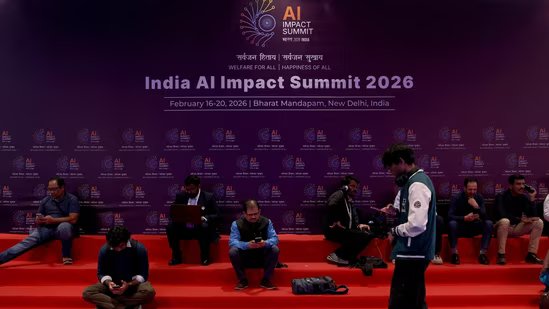
Visitors sit in front of a banner of India AI Impact Summit at Bharat Mandapam in New Delhi. The third day of the India AI Impact Summit 2026 is upon us, brought on by light showers in New Delhi. The event, being held at the Bharat Mandapam across 10 arenas covering 70,000 square metres, includes delegates from a myriad countries and the who’s who of the AI world. Key events at India AI Summit today Today, the India AI Impact Summit is primarily dedicated to bridging the gap between academic research and industrial application. While the formal grand inauguration by Prime Minister Narendra Modi is scheduled for Thursday, today features several high-impact technical and industry-focused sessions. 1. Research Symposium (Center Stage) Organised in partnership with IIIT Hyderabad, this is the principal academic platform of the summit. • Frontier Research: Presentation of cutting-edge AI research from across the Global South. • Poster Showcase: A display of 250+ research submissions focusing on AI-driven scientific discovery and safety frameworks. • Global South Showcase: Emphasis on equitable access to compute and research collaboration among developing nations. 2. Industry & Innovation Sessions These sessions bring together global technology leaders and startups to discuss real-world deployments. • Democratizing Compute: A key panel (1:30 PM – 2:30 PM) featuring executives from Nvidia, IBM, Qualcomm, and HP India discussing regional infrastructure. • AI by HER: Finalists of the Global Impact Challenge for women-led startups will demo their solutions at Sushma Swaraj Bhawan. • IndiaAI Tinkerpreneur: An announcement session for the winners of the national student bootcamp and hackathons. 3. Key Governance & Policy Releases • Governance Guidelines: The formal release of the India AI Governance Guidelines. • Mineral Targeting Hackathon: Announcement of the winners of the IndiaAI Hackathon on Mineral Targeting. 4. AI Impact Expo The massive 70,000 sq. mt. expo remains open to registered visitors. • Thematic Pavilions: 300+ exhibitors from 30 countries are showcasing “Sovereign AI” models and hardware. • Interactive Demos: Features like AI-powered cricket coaching (at the Google pavilion) and AI applications in traditional crafts (weaving). …Read More Key events at India AI Summit today Today, the India AI Impact Summit is primarily dedicated to bridging the gap between academic research and industrial application. While the formal grand inauguration by Prime Minister Narendra Modi is scheduled for Thursday, today features several high-impact technical and industry-focused sessions. 1. Research Symposium (Center Stage) Organised in partnership with IIIT Hyderabad, this is the principal academic platform of the summit. • Frontier Research: Presentation of cutting-edge AI research from across the Global South. • Poster Showcase: A display of 250+ research submissions focusing on AI-driven scientific discovery and safety frameworks. • Global South Showcase: Emphasis on equitable access to compute and research collaboration among developing nations. 2. Industry & Innovation Sessions These sessions bring together global technology leaders and startups to discuss real-world deployments. • Democratizing Compute: A key panel (1:30 PM – 2:30 PM) featuring executives from Nvidia, IBM, Qualcomm, and HP India discussing regional infrastructure. • AI by HER: Finalists of the Global Impact Challenge for women-led startups will demo their solutions at Sushma Swaraj Bhawan. • IndiaAI Tinkerpreneur: An announcement session for the winners of the national student bootcamp and hackathons. 3. Key Governance & Policy Releases • Governance Guidelines: The formal release of the India AI Governance Guidelines. • Mineral Targeting Hackathon: Announcement of the winners of the IndiaAI Hackathon on Mineral Targeting. 4. AI Impact Expo The massive 70,000 sq. mt. expo remains open to registered visitors. • Thematic Pavilions: 300+ exhibitors from 30 countries are showcasing “Sovereign AI” models and hardware. • Interactive Demos: Features like AI-powered cricket coaching (at the Google pavilion) and AI applications in traditional crafts (weaving). Follow all the updates here: Feb 18, 2026 9:37:25 AM IST India AI Summit LIVE: The ‘robot dog’ controversy Galgotias University has clarified that the “robodog” it showed at the India AI Impact Summit 2026 was not developed in-house, and that it never made such a claim. That, despite a video showing a professor of the university saying that the robodog was built in-house. Feb 18, 2026 9:29:31 AM IST India AI Summit LIVE: Traffic advisory for New Delhi Traffic jam near Akshardham Temple, due to restrictions for the India AI Impact Summit and peak-hour rush, in New Delhi on Tuesday, 17 February. (PTI) The Delhi Police has issued a traffic advisory that will be in effect from 4:00 pm to 10:00 pm today, on account of the India AI Impact Summit at Bharat Mandapam. Commuters are advised to plan their travel in advance, avoid affected stretches, and follow directions issued by traffic personnel deployed on duty. Authorities have suggested the following alternate routes to ease congestion during the specified hours. (read more) Feb 18, 2026 9:25:10 AM IST India AI Summit LIVE: Nvidia explains Jensen Huang’s absence Nvidia CEO Jensen Huang could not make it to the India AI Summit as he has caught a bug after three weeks on incessant travel, South Asia MD Vishal Dhupar said. “Aren’t we all missing Jensen? Everywhere I’m going, everyone is asking (about) Jensen,” he said. “Jensen has travelled for three straight weeks, he caught a bug, he is under the weather.” “We hope he is well soon, but we are delighted that we have Jay Puri leading a delegation to India and celebrate this very important week where the India AI Summit will demonstrate the power of India.” Feb 18, 2026 9:11:48 AM IST India AI Summit LIVE: Sundar Pichai lands in New Delhi Alphabet Inc. CEO Sundar Pichai has landed in New Delhi for the India AI Impact Summit 2026. He is set to participate in an exclusive session tomorrow at the Bharat Mandapam. “Nice to be back in India for the AI Impact Summit — a very warm welcome as always and the papers looked great too:),” he wrote on X.